
Callisto denticulella
(Thunberg, 1794)
Garden Apple Slender
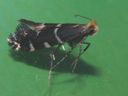
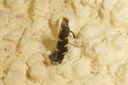
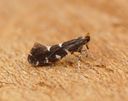
Callisto denticulella is a small leaf-mining in the Gracillariidae. are active from May to June and have a wingspan of approximately 11 mm. The is notable for its distinctive wing pattern featuring white triangular on a brown forewing. Larvae are specialized miners of Malus leaves, with additional records from Crataegus, Cotoneaster, and Pyrus. The species has a broad distribution across Europe, eastern North America, and parts of Russia.
Pronunciation
How to pronounce Callisto denticulella: //kəˈlɪstoʊ dɛnˈtɪkjʊˌlɛlə//
These audio files are automatically generated. While they are not always 100% accurate, they are a good starting point.
Identification
Distinguished from similar Gracillariidae by the specific arrangement of white : three triangular marks on the combined with the two on the inner margin and basal white dot. The evenly brown ground color without additional spotting or banding separates it from with more complex patterns. Genitalia examination may be required for definitive identification where ranges overlap with related Callisto .
Images
Habitat
Associated with containing plants in the Rosaceae , particularly apple (Malus) orchards, hedgerows with hawthorn (Crataegus), and areas with pear (Pyrus) and cotoneaster plantings. Specific microhabitat requirements for larvae are the leaf tissues of these host plants.
Distribution
Present in most of Europe except the Balkan Peninsula and Mediterranean islands. Introduced or native to eastern North America: Canada (Québec, Nova Scotia, British Columbia) and United States (Vermont, Maryland, New Hampshire). Also recorded from Russia (European Central region, East Caucasus region).
Seasonality
on wing from May to June. Single per year inferred from narrow period.
Diet
Larvae are leaf miners feeding on Malus (apple). Additional recorded plants include Crataegus (hawthorn), Cotoneaster, and Pyrus communis (pear). Feeding occurs within leaf tissues, creating characteristic mines.
Host Associations
- Malus - larval food plantprimary
- Crataegus - larval food plantrecorded
- Cotoneaster - larval food plantrecorded
- Pyrus communis - larval food plantrecorded
Life Cycle
Complete with leaf-mining larval stage. Larvae mine leaves of plants. likely occurs within the mine or in leaf litter, though specific details are not well documented. emerge in spring (May-June).
Behavior
Larvae are endophagous leaf miners, feeding between upper and lower leaf . are or with peak activity in late spring. not documented.
Ecological Role
As a , larvae create feeding galleries that may affect photosynthetic capacity of leaves. levels are generally not sufficient to cause significant economic damage to cultivated apples. Serves as prey for and .
Human Relevance
Minor potential pest of apple , though not considered economically significant. Presence in orchards may indicate -free or low-input management. Used as a study organism for leaf-miner and Gracillariidae .
Similar Taxa
- Other Callisto speciesSimilar size, wing shape, and Gracillariidae characteristics; distinguished by specific pattern of white and genitalia
- Phyllonorycter speciesSimilar leaf-mining habit on Rosaceae; distinguished by different wing patterns, often with more complex fasciae rather than discrete
More Details
Taxonomic History
Originally described as Tinea denticulella by Thunberg in 1794, later transferred to Callisto. The genus Callisto is currently placed in tribe Parornichini within Gracillariidae.
Leaf Mine Characteristics
Larval mines on Malus are typically full-depth blotch mines or long serpentine mines, though specific mine varies with leaf thickness and developmental stage.