
Neurobathra strigifinitella
(Clemens, 1860)
Finite-channeled Leafminer Moth
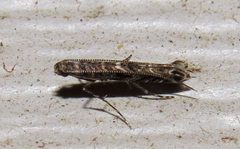
Neurobathra strigifinitella is a small in the Gracillariidae, commonly known as the Finite-channeled Leafminer Moth. The was described by James Brackenridge Clemens in 1860. Its larvae are specialized leaf miners that feed on Fagaceae trees and shrubs, creating distinctive mines in leaves.
Pronunciation
How to pronounce Neurobathra strigifinitella: /ˌnʊəroʊˈbæθrə ˌstrɪdʒɪˌfaɪnɪˈtɛlə/
These audio files are automatically generated. While they are not always 100% accurate, they are a good starting point.
Identification
are small typical of the Gracillariidae . Larval mines are found on the underside of turned-down leaf edges of Castanea, Fagus, and Quercus . Specific adult diagnostic features are not documented in available sources.
Images
Habitat
Associated with deciduous forests and woodlands containing plants in the Fagaceae , particularly areas with Castanea, Fagus, and Quercus .
Distribution
Eastern North America: Canada (Québec, Ontario) and United States (Pennsylvania, Florida, Georgia, Maine, Maryland, Missouri, New York, Texas, Virginia, Kentucky, West Virginia, Illinois).
Diet
Larvae feed on leaves of Castanea (C. dentata, C. pumila, C. sativa), Castanopsis, Fagus species (including F. grandifolia), and Quercus species (Q. nigra, Q. prinoides, Q. rubra, Q. virginiana).
Host Associations
- Castanea dentata - larval food plant
- Castanea pumila - larval food plant
- Castanea sativa - larval food plant
- Castanopsis - larval food plant
- Fagus grandifolia - larval food plant
- Quercus nigra - larval food plant
- Quercus prinoides - larval food plant
- Quercus rubra - larval food plant
- Quercus virginiana - larval food plant
Behavior
Larvae mine leaves of plants, with mines characteristically located under the edge of turned-down leaves.
Ecological Role
; larvae feed internally in leaf tissue, potentially affecting photosynthetic capacity of trees.
Similar Taxa
- Other Gracillariidae leafminersSimilar mining on Fagaceae; precise identification requires examination of genitalia or larval mine characteristics.
More Details
Taxonomic history
Originally described as Stragillaria strigifinitella by Clemens in 1860; later transferred to Neurobathra.