
Phyllonorycter ostryaefoliella
(Clemens, 1859)
Wrinkled Hophornbeam Blotch Miner Moth
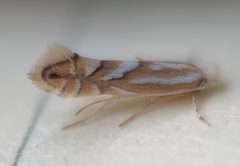
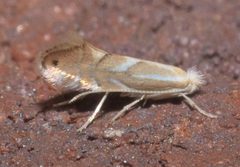
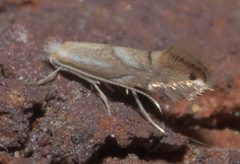
Phyllonorycter ostryaefoliella is a minute in the Gracillariidae, known from eastern North America. have a wingspan of 6–6.5 mm. The is specialized on Ostrya species as larval , with larvae mining the leaves of their host plant.
Pronunciation
How to pronounce Phyllonorycter ostryaefoliella: //ˌfɪloʊnɔːˈrɪktər ˌɒstrɪəˌfoʊliˈɛlə//
These audio files are automatically generated. While they are not always 100% accurate, they are a good starting point.
Identification
Distinguished from other Phyllonorycter by association with Ostrya plants and geographic range in eastern North America. The specific epithet 'ostryaefoliella' directly references the Ostrya leaf host. Leaf mines on Ostrya species may provide the most reliable field identification cue. Similar Phyllonorycter species on other hosts (such as birch, oak, or maple ) can be separated by host association and potentially genitalia dissection.
Images
Habitat
Associated with forests and woodlands containing Ostrya , particularly Ostrya virginiana (American hophornbeam or ironwood). The larval is within the leaves of the plant.
Distribution
Eastern North America: Canada (Nova Scotia, Ontario, Québec) and United States (Connecticut, Illinois, New York, Kentucky, Maine, Vermont).
Diet
Larvae feed on Ostrya , including Ostrya virginiana, mining the leaves of their plant. feeding habits are not documented.
Host Associations
- Ostrya virginiana - larval primary ; larvae mine leaves
- Ostrya - larval -level association
Life Cycle
Larval stage mines leaves of Ostrya . Specific details of placement, site, and number of per year are not documented.
Behavior
have been observed at blacklight. Larvae are leaf miners, feeding internally within leaf tissue.
Ecological Role
As a , larvae create feeding galleries within Ostrya leaves, potentially affecting plant photosynthetic capacity. Specific ecological impacts are not quantified.
Human Relevance
Not known to be of economic or medical importance. The plant Ostrya virginiana is occasionally used as an ornamental tree, but this is not documented as a significant pest.
Similar Taxa
- Other Phyllonorycter speciesMany Phyllonorycter are morphologically similar and require association or genitalia examination for identification. P. ostryaefoliella is distinguished by its specialization on Ostrya.
- Phyllonorycter species on Betula, Quercus, or AcerThese common -alternatives can be eliminated by confirmed association with Ostrya rather than birch, oak, or maple.
More Details
Taxonomic history
Originally described as Lithocolletis ostryaefoliella by Clemens in 1859, later transferred to Phyllonorycter.
Etymology
The specific epithet 'ostryaefoliella' combines the Ostrya with 'foliella' (diminutive of leaf), indicating a small leaf-associated organism on Ostrya.