
Phyllonorycter maestingella
(Müller, 1764)
Beech Midget
Phyllonorycter maestingella is a minute leaf-mining in the Gracillariidae. The is , with flying in spring and late summer. Larvae are specialized miners of beech leaves, creating distinctive blotch mines on the leaf underside. The species has a transcontinental distribution spanning Europe, Russia, and western North America.

Pronunciation
How to pronounce Phyllonorycter maestingella: /fɪloʊˈnɒrɪktər mæstɪnˈdʒɛlə/
These audio files are automatically generated. While they are not always 100% accurate, they are a good starting point.
Identification
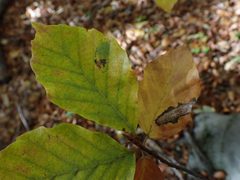
can be recognized by the combination of very small size (7–9 mm wingspan), the distinctive orange-brown and black-and-white wing pattern, and association with beech . The pattern in May-June and August helps distinguish it from some . Larval mines are diagnostic: long blotch mines on the underside of beech leaves, typically between two running from midrib nearly to leaf margin, with piled neatly along the mine's middle and cocoon positioned to one side. Similar Phyllonorycter on beech include P. faginella, which makes a different mine type (upper surface tentiform mine with central frass line).
Images
Appearance
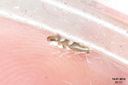
are extremely small with a wingspan of 7–9 mm. The forewings display an intricate pattern of orange-brown, black, and white markings. The overall coloration is mottled and speckled, typical of many Phyllonorycter . The body is slender and compact relative to wing size.
Habitat
Deciduous woodland dominated by beech (Fagus ). The species is tightly associated with mature beech stands where larval plants are available.
Distribution
Europe; Russia (European part); British Columbia, Canada. Records also include New York State in the United States. The distribution reflects the range of its beech plants.
Seasonality
. fly in May and June, with a second in August. Exact timing varies with geographic location and local climate conditions.
Diet
Larvae feed on beech (Fagus ). The pale greenish-yellow larva creates a long blotch mine on the underside of the leaf, positioned between .
Host Associations
- Fagus - larval plantblotch mine on leaf underside
Life Cycle
Complete with , larva, pupa, and stages. Larvae mine beech leaves, creating blotch mines with characteristic arrangement. occurs within the mine in a cocoon positioned to one side of the frass pile. Adults emerge in spring and late summer.
Behavior
Larvae feed as leaf miners, creating blotch mines rather than linear mines. When mines occur at leaf margins, they can cause the leaf to fold downward. are attracted to light.
Ecological Role
Larval leaf mining represents a minor herbivory pressure on beech . The serves as prey for and . Abundant populations may contribute to localized leaf damage but are not considered significant defoliators.
Human Relevance
Minor economic significance. The is not a forestry pest; leaf mining damage is cosmetic and does not impact tree health. Occasionally encountered by naturalists and enthusiasts at light traps.
Similar Taxa
- Phyllonorycter faginellaAlso mines beech leaves, but creates upper surface tentiform mines with in a central line rather than the underside blotch mine with lateral frass pile of P. maestingella
- Other Phyllonorycter species on FagusRequire examination of mine and position; several occur on beech but differ in mine type and location