
Phyllonorycter basistrigella
(Clemens, 1859)
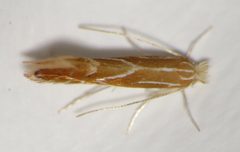
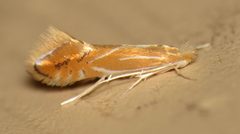
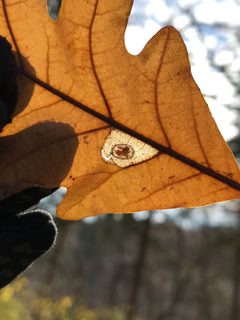
Phyllonorycter basistrigella is a minute leaf-mining in the Gracillariidae. The creates distinctive tentiform mines on the undersides of oak leaves, with larvae constructing an oval ring around the pupal cocoon. It is widely distributed across eastern and western North America, with records from Canada and numerous U.S. states. The wingspan measures approximately 8 mm.
Pronunciation
How to pronounce Phyllonorycter basistrigella: //ˌfɪl.oʊ.nɔːˈrɪk.tər ˌbæsɪstrɪˈdʒɛlə//
These audio files are automatically generated. While they are not always 100% accurate, they are a good starting point.
Identification
The is distinguished from other Phyllonorycter species by the structure of its leaf mine: a flat, tentiform mine on the lower leaf surface that is nearly rectangular, unwrinkled, and positioned between two . The pupal cocoon is surrounded by an oval ring of collected from the mine edges, leaving the transparent so the pupa is visible. This frass ring structure has been used to confirm identification even when plant differs from typical oaks. Final determination may require examination of genitalia or molecular analysis.
Images
Appearance
Very small with wingspan of about 8 mm. are typical of the Phyllonorycter: slender-bodied with narrow, wings. Coloration and pattern details are not well documented in available sources. The larval mine is the most frequently observed life stage: a tentiform mine on the underside of the leaf, positioned between two , nearly rectangular in shape and unwrinkled.
Habitat
Deciduous forests and woodlands where oaks (Quercus ) occur. The species is associated with a variety of oak across its range, from eastern hardwood forests to western oak woodlands.
Distribution
Eastern and western North America. Canada: Québec, Ontario, Nova Scotia, British Columbia. United States: Connecticut, Illinois, Oregon, Kentucky, Maine, Michigan, New York, Vermont, Pennsylvania, Colorado, Massachusetts, Rhode Island, California, Missouri, and Atlantic States region.
Diet
Larvae feed on Quercus including Quercus alba, Quercus bicolor, Quercus castanea, Quercus coccinea, Quercus kelloggii, Quercus macrocarpa, Quercus prinoides, Quercus prinus, Quercus rubra, Quercus stellata, Quercus tinctoria, and Quercus velutina. Also recorded on Castanea crenata. do not feed; larvae are leaf miners.
Host Associations
- Quercus alba - larval food plant
- Quercus bicolor - larval food plant
- Quercus castanea - larval food plant
- Quercus coccinea - larval food plant
- Quercus kelloggii - larval food plant
- Quercus macrocarpa - larval food plant
- Quercus prinoides - larval food plant
- Quercus prinus - larval food plant
- Quercus rubra - larval food plant
- Quercus stellata - larval food plant
- Quercus tinctoria - larval food plant
- Quercus velutina - larval food plant
- Castanea crenata - larval food plant; identification confirmed by ring structure
Life Cycle
Complete with , larva, pupa, and stages. Larvae mine leaves of plants, creating tentiform mines on the underside. At , larvae collect deposited along mine edges and arrange it into an oval ring-like wall around the cocoon, leaving the transparent. The pupa is visible through this transparent covering.
Behavior
Larvae are endophagous leaf miners, feeding internally within leaf tissue. The mining creates a characteristic tentiform blotch on the lower leaf surface. are attracted to light.
Ecological Role
As a , larvae consume photosynthetic tissue of oak leaves, potentially affecting plant . The serves as a food source for and other natural enemies of leaf-mining insects. ring construction may provide some protection for the pupal stage.
Human Relevance
Not a significant pest of economic importance. The may be encountered by botanists and entomologists examining oak foliage, and by citizen scientists participating in monitoring events such as National Moth Week. The distinctive leaf mines can aid in oak identification and forest biodiversity surveys.
Similar Taxa
- Other Phyllonorycter speciesMany also create tentiform mines on oaks; P. basistrigella is distinguished by the rectangular, unwrinkled mine shape and the oval ring around the pupal cocoon.
- Cameraria species (Gracillariidae)Also leaf miners on oaks, but typically create blotch mines rather than tentiform mines, and do not construct the characteristic ring.
More Details
Taxonomic history
Originally described as Lithocolletis basistrigella by Clemens in 1859, later transferred to Phyllonorycter.
Identification reliability
The ring structure around the pupal cocoon has proven to be a reliable diagnostic feature; specimens found on Castanea crenata were identified as P. basistrigella based on this character despite the atypical plant.