Phyllonorycter argentinotella
(Clemens, 1859)
Golden Elm Leafminer
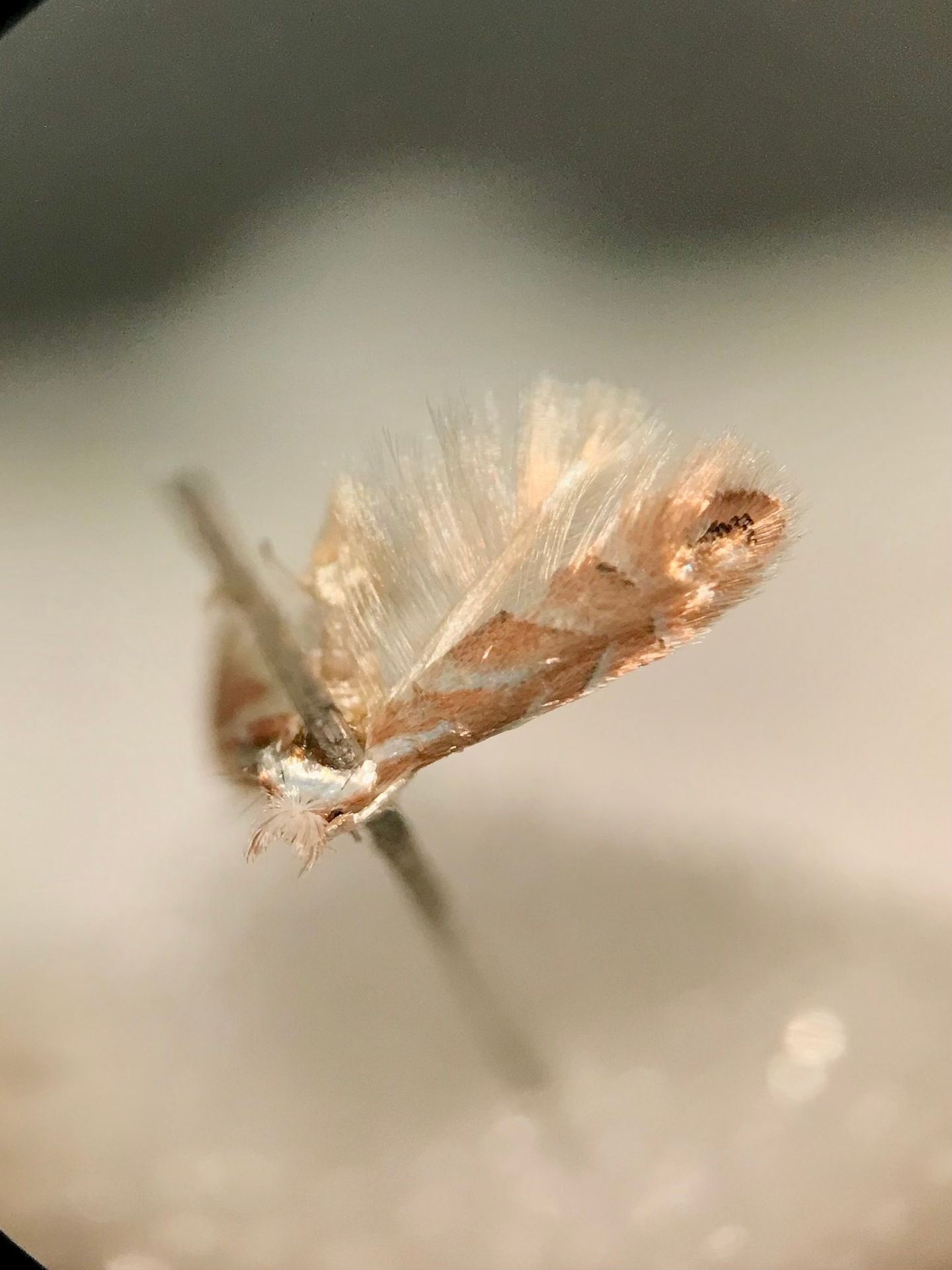
Phyllonorycter argentinotella is a micro- in the Gracillariidae, commonly known as the Golden Elm Leafminer. It is a leaf-mining whose larvae feed on elm leaves (Ulmus species), creating characteristic blotch mines. The species occurs in eastern North America, from Québec south through the northeastern and midwestern United States. are small, with a wingspan of 6.5–8 mm.
Pronunciation
How to pronounce Phyllonorycter argentinotella: /ˌfɪloʊnɔˈrɪktər ˌɑːrdʒɛntɪnoʊˈtɛlə/
These audio files are automatically generated. While they are not always 100% accurate, they are a good starting point.
Identification
Distinguished from other Phyllonorycter by association with elm (Ulmus species) and geographic distribution in eastern North America. Genitalia examination is typically required for definitive species-level identification within this . The larval leaf mines are blotch-type mines on elm leaves, which can help distinguish it from congeneric species that mine other host plants. Similar species include other Phyllonorycter that feed on elms; precise identification requires microscopic examination of specimens.
Images
Appearance
Small with wingspan 6.5–8 mm. As a member of the Phyllonorycter, likely exhibit the typical pattern of this group: narrow, forewings with metallic or iridescent markings, often with pale transverse bands or spots. The specific epithet 'argentinotella' (silver-marked) suggests silvery or pale markings on the wings. Body slender, consistent with microlepidoptera.
Habitat
Associated with elm trees (Ulmus ), particularly in deciduous woodland, riparian corridors, urban and suburban areas where elms are planted, and forest edges. The presence of suitable plants is the primary requirement.
Distribution
Eastern North America: Canada (Québec, Ontario); United States (Illinois, Kentucky, Pennsylvania, New York, Vermont, Connecticut, Massachusetts, Iowa).
Diet
Larvae feed on Ulmus americana, Ulmus fulva, and Ulmus rubra. They mine the leaves of their plant, creating blotch mines. feeding habits are unknown.
Host Associations
- Ulmus americana - larval larvae mine leaves
- Ulmus fulva - larval larvae mine leaves
- Ulmus rubra - larval larvae mine leaves
Life Cycle
Complete with , larval, pupal, and stages. Larvae are leaf miners that feed within elm leaves, creating blotch-type mines. occurs within the mine or in a silken cocoon. Specific details of voltinism (number of per year) are not documented.
Behavior
are attracted to light. Larvae are endophagous leaf miners, feeding internally within leaf tissue rather than externally on the leaf surface.
Ecological Role
As a , larvae contribute to natural herbivory pressure on elm . The is part of the guild of insects associated with elms and may serve as prey for and other natural enemies. It is not known to be a significant pest of ornamental or native elms.
Human Relevance
Minor interest to entomologists and naturalists. Not considered an economically important pest. May be encountered during surveys of urban elm trees or in biodiversity monitoring.
Similar Taxa
- Phyllonorycter ulmifoliellaAlso feeds on elms; requires genitalia examination for separation
- Other Phyllonorycter speciesMany congeneric are morphologically similar and require microscopic identification; plant association helps narrow possibilities
More Details
Taxonomic history
Originally described as Lithocolletis argentinotella by Clemens in 1859; later transferred to Phyllonorycter.
Mining behavior
Larvae create blotch mines—irregular, expanded areas of consumed leaf tissue visible from both upper and lower leaf surfaces. This distinguishes them from linear leaf miners.