
Phyllonorycter albanotella
(Chambers, 1875)
Marginal Tentiform Oak Leafminer
Phyllonorycter albanotella is a minute in the Gracillariidae, commonly known as the Marginal Tentiform Oak Leafminer. have a wingspan of 6–7.5 mm. The is specialized on oaks, with larvae creating distinctive tentiform mines on the undersides of leaves. It occurs in eastern North America from Ontario and Québec south to Texas.
Pronunciation
How to pronounce Phyllonorycter albanotella: //ˌfɪloʊnəˈrɪktər ælbənoʊˈtɛlə//
These audio files are automatically generated. While they are not always 100% accurate, they are a good starting point.
Identification
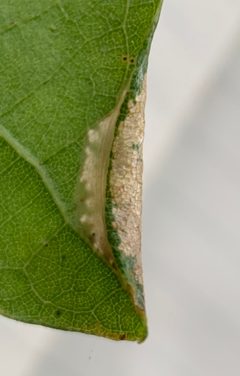
are best identified by a combination of small size (6–7.5 mm wingspan), forewing pattern, and association with oak . Larval mines are diagnostic: small tentiform mines on the underside of oak leaves, positioned at the leaf margin or between , with the loosened thrown into numerous longitudinal wrinkles. The pupa is enclosed in a large, semi-transparent oval silken cocoon within the mine. Distinguished from other Phyllonorycter on oak by mine position and ; P. quercialbella mines are similar but differ in details of wrinkling and cocoon structure.
Images
Appearance
are extremely small with a wingspan of 6–7.5 mm. Like other Phyllonorycter , they have narrow, forewings with characteristic patterning of white and dark markings. The specific wing pattern distinguishes this species from . are long relative to body size. Body is slender and delicate, typical of microlepidoptera.
Habitat
Deciduous forests and woodlands dominated by oak . Occurs in both natural oak stands and urban/suburban areas where oaks are planted. Larval is the leaf underside of living oak foliage.
Distribution
Eastern North America: Canada (Ontario, Québec) and United States (Illinois, Kentucky, Ohio, Texas, Maine, Vermont, Connecticut). Records suggest a primarily eastern and central distribution with southern extension to Texas.
Diet
Larvae feed on Quercus , specifically documented from Quercus alba (white oak), Quercus bicolor (swamp white oak), Quercus macrocarpa (bur oak), Quercus nigra (water oak), and Quercus obtusiloba (post oak). Larvae are leaf miners, feeding on mesophyll tissue within the leaf. feeding habits are not documented.
Host Associations
- Quercus alba - larval white oak
- Quercus bicolor - larval swamp white oak
- Quercus macrocarpa - larval bur oak
- Quercus nigra - larval water oak
- Quercus obtusiloba - larval post oak
Life Cycle
Complete with four stages: , larva, pupa, . Larvae mine oak leaves, creating tentiform mines on the undersides. The mine becomes wrinkled longitudinally. occurs within a semi-transparent oval silken cocoon inside the mine. Adults are active in summer; specific timing varies by latitude.
Behavior
Larvae are endophagous leaf miners, feeding entirely within the leaf tissue. The tentiform mine structure creates a sheltered microhabitat. are likely and have been observed coming to light.
Ecological Role
As a , larvae contribute to natural herbivory on oaks. The mining damage is generally minor and not considered ecologically significant. The serves as prey for and other natural enemies. Pupal cocoons within mines may provide some protection from .
Human Relevance
Not an economic pest; leaf mining damage is cosmetic and does not threaten tree health. May be encountered by entomologists and naturalists studying leaf-mining insects. The is too small and damage too minor to be noticed by most observers.
Similar Taxa
- Phyllonorycter quercialbellaAlso mines oaks; distinguished by mine details and cocoon structure
- Other Phyllonorycter speciesMany create similar tentiform mines; require examination of genitalia or mine characteristics for definitive identification
More Details
Taxonomic history
Described by Chambers in 1875. The epithet 'albanotella' refers to the white (alba) markings on the wings.
Mine morphology
The 'Marginal Tentiform Oak Leafminer' refers to the frequent placement of mines at leaf margins, though mines may also occur between .