
Cremastobombycia grindeliella
(Walsingham, 1891)
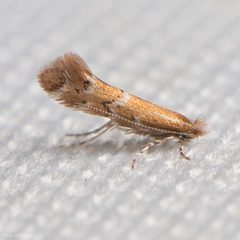
A minute leaf-mining of the Gracillariidae, to California. have a wingspan of approximately 8 mm. Larvae are specialized herbivores that create distinctive mines in the leaves of several Asteraceae .
Pronunciation
How to pronounce Cremastobombycia grindeliella: //krɛˌmæstoʊbɒmˈbɪsiə ˌɡrɪndɛliˈɛlə//
These audio files are automatically generated. While they are not always 100% accurate, they are a good starting point.
Identification
Extremely small size (8 mm wingspan) distinguishes this from most other Lepidoptera. The leaf mines are diagnostic: upper-surface mines cause more leaf contraction and more distinct epidermal folds compared to lower-surface mines. The pupal cocoon is elongate, white, and silken, attached posteriorly by two fine threads and anteriorly by a broad silk band.
Images
Distribution
California, United States.
Diet
Larvae feed on leaves of Anaphalis margaritacea, Gnaphalium , Grindelia camporum, Grindelia robusta, and Pseudognaphalium stramineum (all Asteraceae). They mine leaf tissue rather than consuming leaves externally.
Host Associations
- Anaphalis margaritacea - larval food plant
- Gnaphalium - larval food plant; -level association
- Grindelia camporum - larval food plant
- Grindelia robusta - larval food plant
- Pseudognaphalium stramineum - larval food plant
Life Cycle
Complete with leaf-mining larval stage. Larvae pupate within an elongate white silken cocoon attached to the substrate.
Behavior
Larvae are endophagous leaf miners, feeding internally within leaf tissue. Mining occurs on either leaf surface, with upper-surface mines producing more pronounced leaf distortion.
Ecological Role
Herbivore; on native Asteraceae. Specific ecological impacts unstudied.