
Cameraria pentekes
Opler & Davis, 1981
Cameraria pentekes is a small leaf-mining described by Opler and Davis in 1981. The is restricted to western North America, occurring in British Columbia, Canada, and the states of California and Washington in the United States. Its larvae are specialized miners of oak leaves, feeding exclusively on Quercus douglasii and Quercus lobata. The species name refers to the distinctive five-pointed vincular process of the male genitalia.
Pronunciation
How to pronounce Cameraria pentekes: /kæməˈrɛəriə pɛnˈtiːkiːz/
These audio files are automatically generated. While they are not always 100% accurate, they are a good starting point.
Identification
Identified by the distinctive five-pointed vincular process of the male genitalia, referenced in the epithet. Forewing length of 3–5 mm distinguishes it from larger Cameraria species. Larval mines are oblong to ovoid, opaque green-yellow, located on the lower half of the leaf to one side of the midrib, and positioned along the leaf margin or midrib. Mines typically show many minute parallel folds, occasionally with one or two more pronounced folds.
Images
Appearance
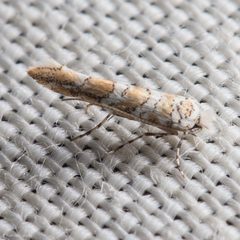
Small with forewings measuring 3–5 mm in length. The is distinguished by male genitalic characters, specifically a vincular process with five pointed projections.
Habitat
Associated with oak woodland and savanna where oaks occur. Larval development occurs within leaves of Quercus douglasii and Quercus lobata.
Distribution
Western North America: British Columbia, Canada; California and Washington, United States.
Diet
Larvae feed on Quercus douglasii (blue oak) and Quercus lobata (valley oak). Mining occurs in leaves of these plants.
Host Associations
- Quercus douglasii - larval Blue oak
- Quercus lobata - larval Valley oak
Life Cycle
Larval stage develops as a within oak leaves, creating oblong to ovoid mines. Mines are solitary, though some leaves may support more than one mine. likely occurs within the mine or in leaf litter, though specific details are not documented.
Behavior
Larvae create solitary leaf mines positioned on the lower half of the leaf, always to one side of the midrib. Mines are found along leaf margins or the midrib and typically display many minute parallel folds in the leaf .
Ecological Role
on two oak ; contributes to herbivore diversity in California oak . The specialized association suggests potential role in oak , though specific impacts are not quantified.
Human Relevance
No documented economic or agricultural significance. Minor ecological interest due to specialized association with California oaks.
Similar Taxa
- Other Cameraria speciesShare leaf-mining habit on oaks and similar small size; distinguished by male genitalic , specifically the five-pointed vincular process, and mine characteristics including position on lower leaf half and parallel fold pattern.
More Details
Etymology
The specific epithet pentekes derives from Greek pente (five) and suffix -ekes (pointed), referring to the diagnostic five-pointed vincular process of the male genitalia.