
Cameraria fletcherella
(Braun, 1908)
Cameraria fletcherella is a small leaf-mining in the Gracillariidae. have a wingspan of 8.5–9 mm. The is known from limited localities in northeastern North America. Larvae are specialized feeders on oak leaves, creating internal mines in foliage.
Pronunciation
How to pronounce Cameraria fletcherella: //ˌkæməˈreɪriə ˌflɛtʃərˈɛlə//
These audio files are automatically generated. While they are not always 100% accurate, they are a good starting point.
Identification
The extremely small size (wingspan under 10 mm) distinguishes this from most other Lepidoptera. Within Cameraria, identification to level requires examination of genitalia or larval association, as external is highly similar among congeneric species. Known distribution in Québec, Ontario, Illinois, and Maine may aid in narrowing possibilities.
Images
Appearance
are minute with a wingspan of 8.5–9 mm. As a member of Gracillariidae, adults likely have narrow, forewings with characteristic patterning typical of the Cameraria, though specific coloration details are not documented in available sources.
Habitat
Associated with oak-dominated forests and woodlands where Quercus occur. Specific microhabitat preferences for are undocumented.
Distribution
Recorded from Québec and Ontario in Canada, and Illinois and Maine in the United States. The disjunct distribution pattern suggests possible under-sampling or specific requirements.
Diet
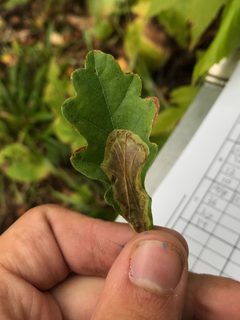
Larvae feed on Quercus , specifically documented from Quercus alba (white oak). They mine the leaves, feeding internally between the epidermal layers. feeding habits are unknown.
Host Associations
- Quercus alba - larval leaf mining
- Quercus - larval multiple may be utilized
Behavior
Larvae are leaf miners, creating internal feeding tunnels (mines) within oak leaves. The specific mine has not been described in available sources.
Ecological Role
As a on oaks, larvae contribute to herbivore diversity and nutrient cycling in oak forest . Their role as prey or is undocumented.
Human Relevance
No documented economic or conservation significance. Too poorly known for assessment of rarity or management needs.
Similar Taxa
- Cameraria spp.All Cameraria are small, similar-looking leaf miners on woody plants; species-level identification requires dissection or association data
- Phyllonorycter spp.Also small Gracillariidae leaf miners, but typically create tentiform mines on undersides of leaves rather than the upper-surface blotch mines characteristic of Cameraria
More Details
Taxonomic history
Described by Annette Frances Braun in 1908, a prolific American lepidopterist who described hundreds of microlepidoptera .