
Cameraria fasciella
(Walsingham, 1891)
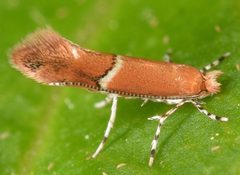
Cameraria fasciella is a micro- in the Gracillariidae, known only from Kentucky and Ohio in the United States. have a wingspan of 6–7 mm. The larvae are leaf miners that feed on Quercus , specifically documented on Quercus tinctoria and Quercus velutina, creating irregular yellowish blotch mines on the upper surface of leaves.
Pronunciation
How to pronounce Cameraria fasciella: //ˌkæməˈraɪə ˌfæsiˈɛlə//
These audio files are automatically generated. While they are not always 100% accurate, they are a good starting point.
Identification
The can be distinguished from other Cameraria by its small size (wingspan 6–7 mm) and geographic restriction to Kentucky and Ohio. Larval mines are irregular yellowish blotches on the upper leaf surface, differing from linear or tentiform mines of other Gracillariidae. identification requires microscopic examination of genitalia; no reliable external diagnostic features are documented in available sources.
Images
Habitat
Associated with oak-dominated where Quercus occur. Specific habitat preferences of are undocumented.
Distribution
to the United States, with confirmed records from Kentucky and Ohio only.
Diet
Larvae feed on Quercus tinctoria and Quercus velutina. feeding habits are unknown.
Host Associations
- Quercus tinctoria - larval food plantleaf mine
- Quercus velutina - larval food plantleaf mine
Life Cycle
Larvae mine leaves of oaks, forming irregular yellowish blotch mines on the upperside. Specific details of , pupal, and stages are undocumented.
Ecological Role
As a , larvae create blotch mines in oak leaves. The ecological significance of this interaction is not quantified.
Similar Taxa
- Other Cameraria speciesMany Cameraria are oak miners with similar mine ; C. fasciella is distinguished by genitalia and geographic range (Kentucky and Ohio).
- Phyllonorycter speciesSome Phyllonorycter create blotch mines on oaks, but typically form tentiform mines on the leaf underside rather than upper surface blotches.
Sources and further reading
- BugGuide
- Wikipedia
- GBIF taxonomy match
- iNaturalist taxon
- Catalogue of Life
- Stories about small insects and making a big difference - Buglife Blog - Buglife
- Reversing insect declines – a matter of personal responsibility before our own existence - Buglife Blog - Buglife
- Surveying the Horehound Long-horn Moth - Buglife Blog - Buglife
- The great potential of citizen science - an opportunity to work together more in the name of preserving insects in 2021 - Buglife Blog - Buglife