
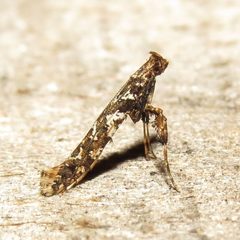
Caloptilia serotinella
(Ely, 1910)
Cherry Leafroller Moth
A small in the Gracillariidae known for its distinctive leaf-rolling larval . The caterpillar constructs leaf rolls on cherry and related plants by spinning silk strands between opposing leaf surfaces, generating collective force exceeding 0.1 N to draw leaves into tight cylinders. are attracted to ultraviolet light and have been documented at moth-lighting events in North America.
Pronunciation
How to pronounce Caloptilia serotinella: //kæˌlɒpˈtɪliə ˌsɛrəʊtɪˈnɛlə//
These audio files are automatically generated. While they are not always 100% accurate, they are a good starting point.
Images
Habitat
Associated with woody containing plants in the Prunus, particularly cherry. Larval habitat consists of living leaves on host trees and shrubs.
Distribution
Eastern and central North America. Documented in Canada from British Columbia, New Brunswick, Newfoundland and Labrador, Nova Scotia, and Ontario.
Seasonality
active during summer months; larvae observed in leaf rolls on foliage during growing season.
Diet
Larvae feed on leaves of cherry (Prunus spp.) and related plants. Specific feeding mode involves mining or rolling leaf tissue within constructed shelters.
Host Associations
- Prunus - larval plantprimary
- Prunus serotina - larval plantblack cherry, inferred from and association
Life Cycle
Complete with , larva, pupa, and stages. Larvae construct silk-bound leaf rolls for shelter and feeding. occurs within the leaf roll.
Behavior
Larvae exhibit specialized leaf-rolling : stretching silk strands fixed between opposing plant surfaces to generate mechanical force for rolling leaves. Caterpillars spin hundreds of silk strands during rolling episodes, with collective force exceeding 0.1 N. Single silk strands stretched approximately 14% beyond equilibrium length exert average axially retractive force of 3.2×10⁻⁵ N. Caterpillars facilitate rolling by weakening the leaf midrib with . After rolling, silk strands undergo supercontraction to bind the roll tightly.
Ecological Role
Herbivore; leaf-rolling larvae modify plant foliage, potentially affecting photosynthetic capacity of individual leaves.
Human Relevance
Minor economic relevance as a foliar feeder on cherry and ornamental Prunus . Documented in citizen science projects including National Week.
Similar Taxa
- Caloptilia blandellaSimilar and leaf-rolling larval habit; distinguished by association and
- Other Caloptilia spp.Congeneric share leaf-mining or leaf-rolling ; specific identification requires examination of genitalia or larval plant
More Details
Silk biomechanics
Larval silk has Young's modulus of 1.1×10⁸ N m⁻² when drawn at 16 mm s⁻¹. Single strands withstand maximum force of 60×10⁻⁵ N before breaking at 30% extension. Wet contraction forces are not harnessed during rolling; supercontraction serves to tighten the roll after construction.