Caloptilia invariabilis
(Braun, 1927)
Cherry Leaf-cone Caterpillar Moth
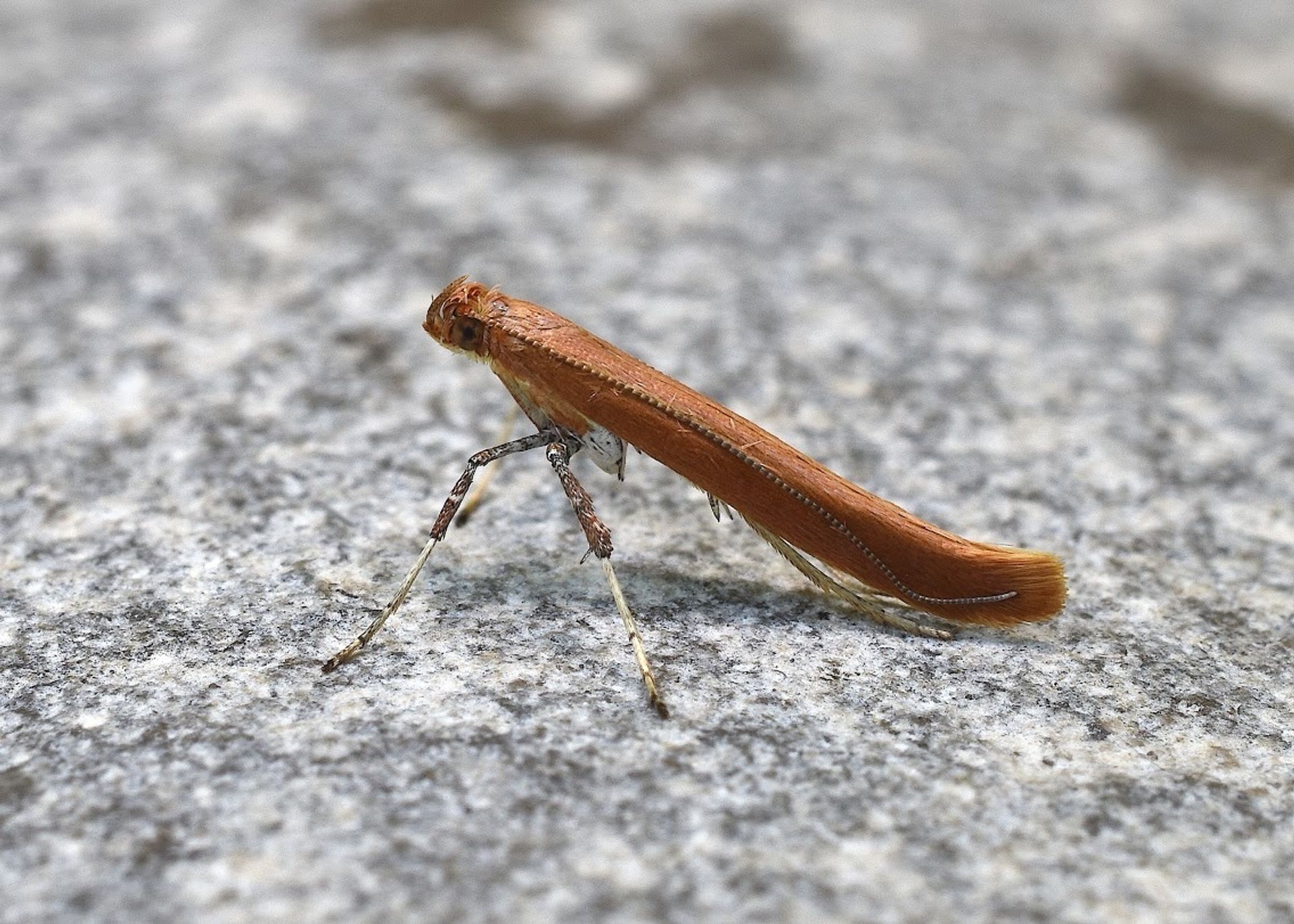
Caloptilia invariabilis is a small in the Gracillariidae, commonly known as the cherry leaf-cone caterpillar moth. The has a wingspan of approximately 15 mm. Its larvae are leaf miners that feed on several Prunus species, creating distinctive mines that begin as linear tracks and terminate in small underside blotches. The species is known from scattered localities in Canada and the United States.
Pronunciation
How to pronounce Caloptilia invariabilis: //ˌkæloʊpˈtɪliə ɪnˌværiˈæbɪlɪs//
These audio files are automatically generated. While they are not always 100% accurate, they are a good starting point.
Identification
This can be distinguished from other Caloptilia by its association with cherry (Prunus) and the specific mine structure produced by its larvae: an indistinct whitish linear mine ending in a small underside blotch with somewhat wrinkled . require microscopic examination for definitive identification. The 'cherry leaf-cone caterpillar ' refers to the larval habit of folding leaf edges, though this specific is more characteristic of later instars in some Caloptilia species.
Images
Appearance
are small with a wingspan of about 15 mm. Specific details of coloration and wing pattern are not documented in available sources.
Habitat
Associated with supporting its plants: Prunus angustifolia (chickasaw plum), Prunus pennsylvanica (pin cherry), Prunus serotina (black cherry), and Prunus virginiana (chokecherry). These include woodlands, forest edges, and areas with native or naturalized cherry .
Distribution
Documented from Canada (Nova Scotia, Ontario, Québec, Alberta, British Columbia, Manitoba, New Brunswick, Newfoundland and Labrador) and the United States (California, Vermont, Tennessee). The disjunct distribution pattern suggests possible under-recording or broader range than currently documented.
Diet
Larvae feed on Prunus angustifolia, Prunus pennsylvanica, Prunus serotina, and Prunus virginiana. They mine the leaves of these plants. feeding habits are not documented.
Host Associations
- Prunus angustifolia - larval Chickasaw plum
- Prunus pennsylvanica - larval Pin cherry
- Prunus serotina - larval Black cherry
- Prunus virginiana - larval Chokecherry
Life Cycle
Larvae are leaf miners. The mine begins as a very indistinct whitish linear track and ends in a small underside blotch. The parenchyma is consumed, leaving the somewhat wrinkled. When the mine reaches the leaf margin, the edge is folded under. Details of , timing, and number of per year are not documented.
Behavior
Larvae exhibit a distinctive mining that includes folding the leaf edge under when mines reach the margin. This is a characteristic behavior of some Caloptilia , though the specific 'cone' formation implied by the is not explicitly described in available sources.
Ecological Role
As a , the larva consumes leaf parenchyma, potentially affecting photosynthetic capacity of trees. The is a herbivore on native Prunus species. Its role in (, ) is not documented.
Human Relevance
No documented economic importance. The feeds on native North American Prunus species rather than cultivated cherries, though Prunus serotina and P. virginiana have some commercial fruit value.
Similar Taxa
- Other Caloptilia speciesMany Caloptilia are morphologically similar and require dissection or analysis for identification. Larval association and mine structure provide the most accessible distinguishing features for C. invariabilis.
- Other Gracillariidae leaf miners on PrunusSeveral gracillariid mine Prunus leaves. The specific mine structure—linear to blotch with marginal leaf folding—helps distinguish C. invariabilis, though confirmation requires rearing .
More Details
Leaf mine characteristics
The larval mine is described as 'very indistinct' and whitish, making it potentially difficult to detect on leaves. The wrinkled and marginal folding are the most visible signs of .
Taxonomic note
Described by Annette Frances Braun in 1927. The specific epithet 'invariabilis' (unchanging, invariable) may refer to morphological consistency or possibly to the uniform appearance of the mines.