
Caloptilia canadensisella
(McDunnough, 1956)
Caloptilia canadensisella is a leaf-mining in the Gracillariidae. It is known from eastern Canada, specifically Nova Scotia and Québec. The larvae feed on Cornus canadensis (bunchberry), creating mines in the leaves of this plant. The was described by James Halliday McDunnough in 1956.
Pronunciation
How to pronounce Caloptilia canadensisella: //ˌkæloʊpˈtɪliə kænəˌdɛnsɪˈsɛlə//
These audio files are automatically generated. While they are not always 100% accurate, they are a good starting point.
Identification
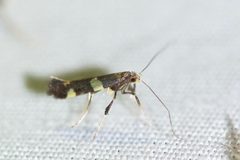
As a member of the Caloptilia, this likely exhibits the characteristic resting posture with wings held roof-like over the body, giving a slender, elongate silhouette. Species-level identification requires examination of genitalia or detailed wing pattern analysis; the specific epithet references its Canadian distribution. It can be distinguished from other Caloptilia species by association with its plant Cornus canadensis and confirmed through dissection or .
Images
Habitat
supporting Cornus canadensis, which grows in and mixed forests, particularly in moist, acidic soils in woodland understories, forest edges, and clearings.
Distribution
Canada: Nova Scotia and Québec. GBIF records also indicate presence in Alberta, though this may require verification.
Diet
Larvae feed on Cornus canadensis (bunchberry). They mine the leaves of this plant.
Host Associations
- Cornus canadensis - larval
Life Cycle
Larval stage mines leaves of Cornus canadensis. Specific details of and timing are not documented.
Behavior
Larvae are leaf miners, feeding internally within leaf tissue. are and attracted to light.
Ecological Role
As a , larvae may influence leaf physiology of Cornus canadensis. Specific ecological impacts are not documented.
Similar Taxa
- Other Caloptilia speciesMany Caloptilia are leaf miners with similar ; identification requires plant association or genitalia examination. The specific association with Cornus canadensis helps distinguish C. canadensisella from .
- Phyllonorycter speciesAlso Gracillariidae leaf miners, but typically create blotch mines rather than the serpentine or blotch mines of Caloptilia, and often have different associations.