
Haematopis
Hübner, 1823
Chickweed Geometer
Species Guides
1- Haematopis grataria(Chickweed Geometer Moth)
Haematopis is a in the Geometridae, containing the single Haematopis grataria, commonly known as the chickweed geometer. This small, day-flying moth is widespread across North America, recognized by its pale yellow wings marked with distinctive pink or red bands and spots. The genus was erected by Jacob Hübner in 1823, with the species described by Johan Christian Fabricius in the same year.
Pronunciation
How to pronounce Haematopis: /ˌhiːməˈtoʊpɪs/
These audio files are automatically generated. While they are not always 100% accurate, they are a good starting point.
Identification
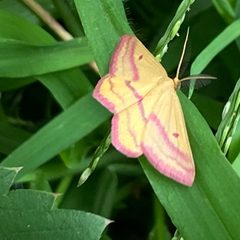
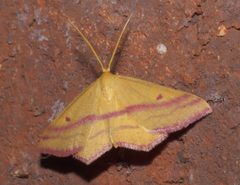
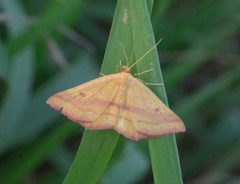
Haematopis contains only one , Haematopis grataria, which can be identified by its pale yellow wings with two pink or red transverse bands on both forewings and hindwings, appearing continuous when at rest, plus a small red or pink spot centrally on each forewing. Males possess conspicuously feathered , while females have thin, thread-like antennae. rest with wings held flat and spread to the sides. Wingspan ranges 20–25 mm.
Images
Habitat
Occurs in diverse environments where low-growing herbaceous vegetation is present, including lawns, meadows, fields, and open woodlands.
Distribution
Throughout the United States; in Canada from Quebec west to Alberta, north to the Northwest Territories.
Seasonality
active from May to October.
Diet
Larvae feed on various low-growing plants including Stellaria (chickweeds), Polygonum (knotweeds), and Trifolium (clovers). diet not documented.
Life Cycle
Complete with , larva, pupa, and stages. Specific details of site and stage not documented.
Behavior
are day-flying, an uncommon trait among geometrid moths.
Ecological Role
Larval herbivory on low-growing plants; may contribute to pollination as day-flying insects.
Human Relevance
Larvae feed on chickweed (Stellaria), a common agricultural and garden weed, potentially providing minor .
Similar Taxa
- XanthotypeCrocus geometer moths share similar yellow coloration and banded wing patterns, but lack the distinctive pink/red spot on the forewing and show different antennal dimorphism between sexes.
- Other Sterrhinae generaMany geometrids in this have banded wings, but Haematopis is distinguished by the specific combination of pale yellow ground color, pink/red bands, central forewing spot, and sexually dimorphic .