
Cyclophora nanaria
(Walker, 1861)
Dwarf Tawny Wave
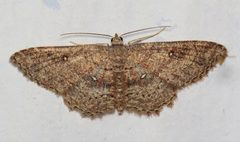
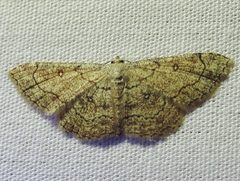
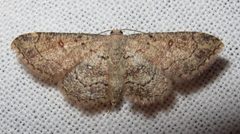
Cyclophora nanaria, the Dwarf Tawny Wave, is a small geometrid first described by Francis Walker in 1861. It is one of the smallest members of its , with a wingspan of approximately 16 mm. The has a broad distribution across the Americas, from the United States through the Caribbean and Central America to South America, and has been introduced to Hawaii.
Pronunciation
How to pronounce Cyclophora nanaria: /sɪkˈlɒfərə næˈnɛərɪə/
These audio files are automatically generated. While they are not always 100% accurate, they are a good starting point.
Identification
Distinguished from other Cyclophora by its exceptionally small size; at approximately 16 mm wingspan, it is notably smaller than such as C. pendulinaria. The specific epithet 'nanaria' (from Latin 'nanus', dwarf) reflects this diminutive stature. Identification to species typically requires examination of genitalia or association with geographic range.
Images
Habitat
Specific preferences are not well documented. As a geometrid , larvae likely feed on woody or herbaceous plants. are attracted to light.
Distribution
Native to the Americas: United States (California to Texas, New Jersey to Florida along the Gulf Coast), Caribbean (Dominica, Jamaica), and South America (south to Argentina). Introduced to Hawaii.
Similar Taxa
- Cyclophora pendulinariaLarger with similar wing pattern; C. nanaria distinguished by smaller size (~16 mm vs. larger wingspan in C. pendulinaria)
- Other Cyclophora speciesC. nanaria is the smallest member of the in its range, with wingspan approximately half that of many
More Details
Taxonomic note
The specific epithet 'nanaria' derives from Latin 'nanus' meaning dwarf, directly referencing the ' notably small size relative to other Cyclophora .
Introduction history
Established as an introduced in Hawaii; mechanism and date of introduction not documented in available sources.