
Cyclophora pendulinaria
(Guenée, [1858])
sweetfern geometer moth, pearly-grey wave
A small geometrid with wingspan 17–26 mm, found across much of North America from Newfoundland to the Yukon and south to Georgia. are active from spring through fall, with larvae feeding on sweetfern (Comptonia) and alder (Alnus) leaves. The inhabits moist to mesic forests.
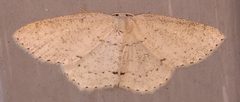
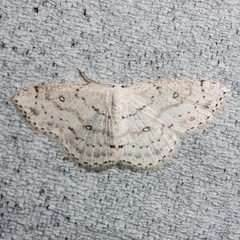

Pronunciation
How to pronounce Cyclophora pendulinaria: //saɪˈklɒfərə ˌpɛndjʊˈlɪnəriə//
These audio files are automatically generated. While they are not always 100% accurate, they are a good starting point.
Identification
The combination of small size (17–26 mm wingspan), pearly-grey coloration with wavy wing patterns, and in moist forests helps distinguish . The reduced number of (2–3 pairs) in larvae is diagnostic for Geometridae; this specifically can be associated with its plants Comptonia and Alnus. Similar Cyclophora species may require dissection or expert examination for definitive identification.
Images
Appearance
have a wingspan of 17–26 mm. The 'pearly-grey wave' describes the coloration and wing pattern. As a geometrid , the adult body is relatively slender. Larvae have reduced compared to many caterpillars—typically two or three pairs rather than the five pairs common in other —giving them the characteristic 'looper' or 'inchworm' movement.
Habitat
Moist or mesic forests. The is associated with its larval plants sweetfern and alder, which grow in these conditions.
Distribution
North America: Newfoundland and Labrador west to Yukon and coastal British Columbia, south to Georgia in the eastern United States.
Seasonality
have been recorded on wing from April to October, indicating a multi-month period spanning spring through fall.
Diet
Larvae feed on leaves of Comptonia (sweetfern) and Alnus (alder) . feeding habits are not documented in available sources.
Host Associations
- Comptonia - larval plantleaves
- Alnus - larval plantleaves
Life Cycle
Complete with , larva, pupa, and stages. Larvae are geometrid 'loopers' with reduced . Voltinism (number of per year) is not documented in available sources.
Behavior
Larvae exhibit the characteristic looping gait of geometrid caterpillars due to their reduced number of . is not well documented beyond period.
Ecological Role
As a herbivore in larval stage, contributes to nutrient cycling in forest through leaf consumption. Serves as prey for various and .
Human Relevance
No significant direct human relevance documented. The is not reported as an agricultural or forestry pest.
Similar Taxa
- Cyclophora packardiSame , similar size and appearance; may require expert examination to distinguish
- Other Cyclophora species members share similar wing patterns and preferences; identification often requires genitalia dissection or molecular analysis