
Disclisioprocta stellata
(Guenée, [1858])
somber carpet, bougainvillea looper
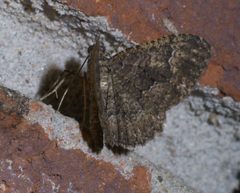
Disclisioprocta stellata is a small geometrid with a broad intercontinental distribution spanning sub-Saharan Africa, the Indian Ocean islands, and the Americas from Canada to South America. The was introduced to Hawaii in 1993 and has established there. are active year-round in southern regions and during late summer and fall in northern areas. The larvae feed on a variety of plants including bougainvillea, giving rise to one of its .


Pronunciation
How to pronounce Disclisioprocta stellata: /dɪsˌklaɪzi.oʊˈprɒkta stɛˈlæta/
These audio files are automatically generated. While they are not always 100% accurate, they are a good starting point.
Identification
The somber carpet can be distinguished from similar geometrid moths by its combination of small size (25–33 mm wingspan), subdued gray-brown coloration without bold transverse lines or bands, and the presence of subtle stellate markings on the wings. The broad, somewhat triangular wing shape and relatively uniform coloration separate it from more patterned and related . In North America, it may be confused with other small Larentiinae, but the lack of strong contrasting patterns and the specific wing shape are diagnostic. The 'bougainvillea looper' refers to the larval stage and its distinctive looping movement; this , combined with plant association, can aid in identification of immatures.
Images
Habitat
Occupies diverse across its extensive range, including tropical and subtropical regions, temperate deciduous forests, urban and suburban gardens, and agricultural areas. In North America, found in dry-mesic upland forests, open woodlands, and disturbed habitats. The shows adaptability to human-modified environments, particularly where plants are cultivated.
Distribution
Native to sub-Saharan Africa, the islands of the Indian Ocean, and the Americas from eastern Canada (Ontario, Quebec, New Brunswick) south through the United States, Mexico, the Antilles, Bahamas, and Bermuda Islands to Bolivia and Brazil. Introduced to Hawaii in 1993, where it has established. The exhibits a disjunct distribution with on multiple continents, suggesting either natural capabilities or human-mediated introduction to some areas.
Seasonality
In North America, are active year-round in southern portions of the range. In northern areas, period extends from July to November. In tropical and subtropical regions, activity likely occurs throughout the year with possible seasonal peaks related to rainfall or plant availability.
Diet
Larvae have been recorded feeding on Amaranthus, Proboscidea, Bougainvillea, Boerhaavia erecta, Pisonia , and Mirabilis jalapa. The breadth of recorded suggests herbivory within several plant , with particular association with Nyctaginaceae (Bougainvillea, Boerhaavia, Pisonia, Mirabilis). feeding habits are not documented but adults of related geometrid moths typically do not feed or consume nectar.
Host Associations
- Bougainvillea - larval food plantGives rise to 'bougainvillea looper'
- Amaranthus - larval food plant
- Proboscidea - larval food plant
- Boerhaavia erecta - larval food plant
- Pisonia aculeata - larval food plant
- Mirabilis jalapa - larval food plant
Life Cycle
Complete with , larva, pupa, and stages. Larvae are the active feeding stage and move with characteristic looping gait due to reduced number of . likely occurs in soil or leaf litter, though specific details are not documented. Adults are and attracted to light. Multiple per year are probable in tropical and subtropical regions; generation number in temperate areas is not established but likely includes at least two generations based on extended period.
Behavior
are and have been observed at ultraviolet light sources. Larvae exhibit the characteristic 'looping' locomotion of geometrid caterpillars, arching the body to bring the forward to meet the thoracic legs. When disturbed, larvae may drop from plants on silk threads. Specific antipredator or other notable adult behaviors are not documented.
Ecological Role
Larvae function as herbivores, consuming foliage of diverse plant . The species likely serves as prey for various including birds, , and other arthropods. may contribute to pollination if they feed on nectar, though this has not been documented. The introduced Hawaiian represents a novel herbivore in that with potential impacts on native and ornamental plants.
Human Relevance
Considered a minor pest of ornamental bougainvillea in some regions, giving rise to the 'bougainvillea looper.' The is not known to cause significant economic damage to agriculture. It is occasionally encountered by entomologists and naturalists at light traps. The Hawaiian introduction in 1993 represents a case of accidental transport, likely via horticultural trade.
Similar Taxa
- Other Disclisioprocta species share similar size and general appearance; D. stellata is distinguished by specific wing pattern elements and distribution
- Small Larentiinae moths (Geometridae)Many small geometrids have subdued coloration; D. stellata separated by wing shape, presence of stellate markings, and specific associations
- Eupithecia speciesSimilar size and cryptic coloration; Eupithecia typically have more pointed forewings and different wing patterns
More Details
Subspecies
Two are recognized: Disclisioprocta stellata stellata (Americas, from Canada to Brazil and Bolivia) and Disclisioprocta stellata natalata Walker (Africa south of Sahara, Madagascar, and islands of the Indian Ocean). The subspecies differ in geographic distribution but morphological distinctions are subtle.
Introduction history
The 1993 introduction to Hawaii represents a documented case of range expansion via human activity. The has successfully established in the Hawaiian Islands, where it adds to the non-native lepidopteran fauna.
Sources and further reading
- BugGuide
- Wikipedia
- GBIF taxonomy match
- iNaturalist taxon
- NCBI Taxonomy
- Catalogue of Life
- Bug Eric: Spider Sunday: Star-bellied Orbweaver, Acanthepeira stellata
- Bug Eric: Spider Sunday: Starbellied Orbweaver
- Megalopygidae | Beetles In The Bush
- A Riot of Colors | Beetles In The Bush
- These are a few of my favorite trees | Beetles In The Bush
- Cynipidae | Beetles In The Bush