
Heterophleps triguttaria
Herrich-Schäffer, 1854
three-spotted fillip
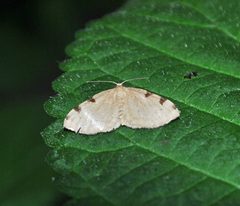
Heterophleps triguttaria, commonly known as the three-spotted fillip, is a small geometrid in the Larentiinae. The is recognized by the three dark spots on its forewings that give it its . It is widely distributed across North America and is among the more frequently observed geometrid moths, with thousands of citizen science records.
Pronunciation
How to pronounce Heterophleps triguttaria: /ˌhɛt.əˈrɒf.lɛps tɹɪˌɡʌtˈtɛə.ri.ə/
These audio files are automatically generated. While they are not always 100% accurate, they are a good starting point.
Identification
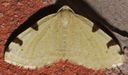
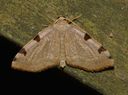
The three dark spots on the forewings are diagnostic and give the its . Similar Heterophleps species lack this precise three-spot pattern. The plain, unmarked hindwings help distinguish it from some related that have patterned hindwings. Overall size and wing shape are consistent with other small Larentiinae.
Images
Appearance
Small with wingspan approximately 15-20 mm. Forewings are pale gray to whitish with three distinct dark spots: one near the wing base, one at the , and one near the outer margin. Hindwings are plain pale gray without markings. Body is slender and relatively unmarked.
Habitat
Found in diverse terrestrial including deciduous and mixed forests, woodland edges, and suburban areas with trees. are attracted to light, suggesting activity in open areas near vegetation.
Distribution
Widely distributed across North America. Documented from Canada (including Quebec and Ontario) through the eastern and central United States, with records extending westward. Vermont records confirmed.
Seasonality
are active primarily from late spring through summer, with peak activity in June and July in northern parts of the range. Multiple may occur in southern portions of the range.
Behavior
are and attracted to artificial light sources. Larval is poorly documented.
Ecological Role
may contribute to pollination as they visit flowers. Larval feeding habits are insufficiently documented to assess role as herbivores.
Human Relevance
Commonly encountered by citizen scientists and enthusiasts due to its attraction to light. The is well-represented in biodiversity databases, contributing to understanding of moth distributions.
Similar Taxa
- Heterophleps refusariaSimilar size and general appearance, but lacks the distinct three-spot forewing pattern; has more diffuse or irregular markings
- Other Larentiinae mothsMany small geometrids share similar size and coloration, but the specific three-spot pattern is unique to H. triguttaria among common North American
More Details
Taxonomic history
Originally described by Herrich-Schäffer in 1854. The specific epithet 'triguttaria' refers to the three spots (from Latin 'tri-' three, 'gutta' spot). MONA/Hodges number 7647.
Citizen science importance
With nearly 4,000 observations on iNaturalist, this is among the more frequently documented geometrid moths in North America, providing valuable data on and distribution.