
Mesoleuca
Hübner, 1825
white-ribboned carpets
Species Guides
2- Mesoleuca gratulata(Western White-Ribboned Carpet)
- Mesoleuca ruficillata(white-ribboned carpet moth)
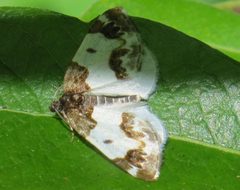
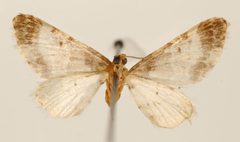
Mesoleuca is a of geometer moths in the Geometridae, Larentiinae, first described by Jacob Hübner in 1825. The genus name derives from Greek 'mesos' (middle) and 'leucos' (white), referring to the characteristic white area on the forewing. are commonly known as white-ribboned or beautiful carpets. The genus includes at least three recognized species: M. albicillata (beautiful carpet), M. gratulata (western white-ribboned carpet moth), and M. ruficillata (white-ribboned carpet moth).

Pronunciation
How to pronounce Mesoleuca: /ˌmɛsoʊˈluːkə/
These audio files are automatically generated. While they are not always 100% accurate, they are a good starting point.
Identification
Forewings with distinctive white or pale band crossing the middle of the wing, creating a 'ribbon' effect that gives the group its . Pattern and coloration of this median band, along with its width and shape, are primary distinguishing features among . M. albicillata has broader white banding; M. ruficillata shows reddish-brown tones in the basal and terminal wing areas; M. gratulata occurs in western North America and may show regional pattern variation.
Images
Distribution
Northern Europe (Denmark, Norway, Sweden); North America (Vermont, United States, and broader US distribution). -level distributions vary: M. albicillata occurs in Europe; M. gratulata in western North America; M. ruficillata in North America.
Similar Taxa
- Other Larentiinae carpetsSimilar wing shape and resting posture; distinguished by Mesoleuca's characteristic white forewing band, which is not present in most related
- XanthorhoeOverlapping distribution and similar size; Xanthorhoe typically shows more uniform or banded patterns without the distinct isolated white patch
- EpirrhoeSimilar carpet moth appearance; Epirrhoe usually display more strongly wavy transverse lines rather than a discrete pale area
Sources and further reading
- BugGuide
- Wikipedia
- GBIF taxonomy match
- iNaturalist taxon
- NCBI Taxonomy
- Catalogue of Life
- Quantifying the Geometric Shell Shape between Populations of True Limpets Lottia Mesoleuca (Mollusca: Lottidae) in Colombia
- A new population of the Cone-billed Tanager Conothraupis mesoleuca, with information on the biology, behaviour and type locality of the species