
Eupithecia palpata
Packard, 1873
small pine looper
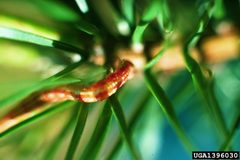
Eupithecia palpata, commonly known as the small pine looper, is a in the Geometridae. First described by Alpheus Spring Packard in 1873, this occurs across Canada and the northeastern United States. The larvae feed on conifers including balsam fir, eastern hemlock, eastern larch, pines, and spruces. have been observed visiting flowers, including apple blossoms, suggesting a role in pollination.

Pronunciation
How to pronounce Eupithecia palpata: /juːpɪˈθiːʃiə pælˈpeɪtə/
These audio files are automatically generated. While they are not always 100% accurate, they are a good starting point.
Identification
Members of the Eupithecia are recognized by their narrow wings and unique resting posture, earning them the 'pugs.' Specific identification of E. palpata to level requires examination of genitalia characters, as is typical for this genus where external alone is often insufficient for definitive identification.
Images
Appearance
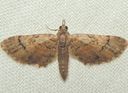
have a wingspan of approximately 23 mm. Like other members of the Eupithecia, it possesses narrow wings and exhibits a distinctive resting posture. The overall coloration and pattern details are typical of 'pug' in this genus.
Habitat
Spruce woods and coniferous forest . The is associated with conifer-dominated environments where larval plants occur.
Distribution
Canada: Newfoundland, Nova Scotia, Prince Edward Island, New Brunswick, Quebec, Ontario, Manitoba, Saskatchewan, Alberta, and British Columbia. United States: northeastern regions.
Diet
Larvae feed on balsam fir (Abies balsamea), eastern hemlock (Tsuga canadensis), eastern larch (Larix laricina), pines (Pinus spp.), and spruces (Picea spp.). The diet possibly extends to other conifers.
Host Associations
- Abies balsamea - larval food plantbalsam fir
- Tsuga canadensis - larval food planteastern hemlock
- Larix laricina - larval food planteastern larch
- Pinus - larval food plantpines
- Picea - larval food plantspruces
Behavior
are and have been observed visiting flowers at night, including apple blossoms. They are attracted to lights.
Ecological Role
Larvae function as conifer-feeding herbivores. have been documented as of apple flowers, contributing to pollination services in agricultural settings.
Human Relevance
provide pollination services that may benefit fruit production, as demonstrated in studies of apple pollination. Larvae feed on conifers but are not noted as significant economic pests.
Similar Taxa
- Other Eupithecia speciesMany 'pug' in this share narrow wings and similar resting postures, requiring genitalia examination for reliable -level identification.
More Details
Taxonomic note
The Eupithecia contains numerous that are difficult to distinguish based on external alone. Dissection of genitalia is typically required for definitive identification.
Pollination research
A 2021 study in the Journal of Economic Entomology documented Eupithecia visiting apple flowers at night, contributing to pollination in orchard settings.