
Gandaritis
Moore, 1868
Species Guides
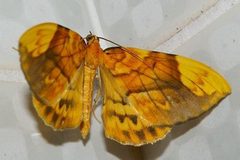
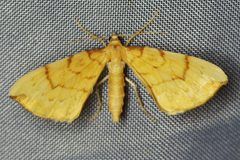
1- Gandaritis atricolorata(Dark-banded Geometer Moth)
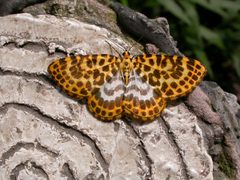
Gandaritis is a of geometrid moths comprising approximately 22 , with 16 species recorded from China. The genus was established by Frederic Moore in 1868. Species within this genus are primarily distributed across the Palearctic region, with notable diversity in montane areas of western China. The Barred Straw (G. pyraliata) is the best-studied species, having been sequenced for genomic analysis.
Pronunciation
How to pronounce Gandaritis: //ɡænˈdæɹɪtɪs//
These audio files are automatically generated. While they are not always 100% accurate, they are a good starting point.
Identification
-level identification within Gandaritis relies on wing pattern differences, particularly maculation and ground color, and requires examination of male and female genitalia . Secondary sexual characteristics are absent in this . (COI) has been used to distinguish closely related species, with interspecific genetic distances ranging from 2.11% to 5.30% between tested species pairs.
Images
Habitat
occupy montane regions at elevations from 1062 m to 3000 m in western China (Sichuan, Shaanxi, Gansu). G. pyraliata occurs in herbaceous vegetation across Europe and Asia, including Britain as far north as Orkney.
Distribution
Widely distributed across the Palearctic region. Documented from China (Sichuan, Shaanxi, Gansu provinces), Europe including Scandinavia (Denmark, Norway, Sweden), and Asia. GBIF records confirm presence in northern Europe.
Seasonality
G. pyraliata are on the wing from June to August in southern Britain. Larvae develop from April to June. overwinter.
Diet
Larvae of G. pyraliata feed primarily on Galium aparine (cleavers). plants for other in the are not documented.
Host Associations
- Galium aparine - larval food plantprimary for G. pyraliata
Life Cycle
G. pyraliata: overwinter; larval development occurs April to June; June to August in southern Britain. details for other are not documented.
Behavior
G. pyraliata rests with wings outstretched and held aloft at an angle above horizontal, with hindwings rotated forward under forewings and the trailing edge curled. This posture renders only one pair of wings visible and may reduce detection by visual in herbaceous vegetation.
Similar Taxa
- Other Larentiinae generasimilar wing patterns and genitalia structure; Gandaritis distinguished by specific combinations of wing maculation and genital detailed in taxonomic revisions
More Details
Genomic resources
G. pyraliata assembly: 295.6 Mb, 31 chromosomal pseudomolecules including W and Z , 15,805 protein-coding genes. Specimen from Wytham Woods, Oxfordshire, UK.
Taxonomic research
Recent taxonomic work on G. flavomacularia and related described G. stueningi as new from western China, based on morphological and molecular evidence.
Sources and further reading
- BugGuide
- Wikipedia
- GBIF taxonomy match
- iNaturalist taxon
- NCBI Taxonomy
- Catalogue of Life
- The genome sequence of the Barred Straw, Gandaritis pyraliata (Denis & Schiffermüller, 1775).
- A taxonomic study of Gandaritis flavomacularia and related species (Lepidoptera, Geometridae), with description of a new species from western China.