
Carsia sororiata
(Hübner, [1813])
Manchester Treble-bar, Manchester Treble-bar Moth
Carsia sororiata is a geometrid with a Holarctic distribution spanning northern and central Europe through Siberia to the Russian Far East and northern Mongolia, with a separate North American range from Alaska to Newfoundland and New Hampshire. are active from July to August. The exhibits notable wing pattern variation across its range, with several described .
Pronunciation
How to pronounce Carsia sororiata: //ˈkɑːr.si.ə ˌsɔːˌrɔː.riˈeɪ.tə//
These audio files are automatically generated. While they are not always 100% accurate, they are a good starting point.
Identification
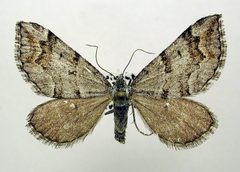
Distinguished from similar geometrids by the combination of two wide forewing cross lines with the characteristic bent outer line bearing two outward-pointing spikes. The 'bridge' formed where the two lines connect in the wing half, when present, is diagnostic. imbutata (Central Europe) is additionally marked by reddish-brown suffusion in the wing field. Separation from related Carsia requires examination of genitalia.
Images
Distribution
Northern and central Europe; Urals; Siberia; Russian Far East; northern Mongolia; North America from Alaska to Newfoundland and south to New Hampshire. GBIF records confirm presence in Alberta, Manitoba, and Saskatchewan, Canada.
Seasonality
on wing July to August. Single-brooded.
Diet
Larvae feed on Vaccinium uliginosum, V. oxycoccos, V. myrtillus, and Rubus arcticus.
Life Cycle
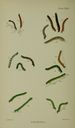
initially whitish yellow, becoming deeper yellow; micropylar rosette 8-leaved with irregular reticulation. Larva stout, uniform thickness, surface deep brownish-red with fine blackish-red dorsal and lines, broad bright yellow lateral stripe with red spots at folds between middle segments, venter pale greenish yellow with paler dark-edged central line. details not documented.
Ecological Role
Larval herbivore on Ericaceae and Rosaceae shrubs in and montane .
Similar Taxa
- Other Carsia speciesGenitalia examination required for definitive separation
- Subspecies imbutata vs. nominate sororiataImbutata distinguished by reddish-brown wing suffusion and more variegated pattern with distinct sub-basal line and two bands