
Synchlora herbaria
(Fabricius, 1794)
White-dotted Emerald
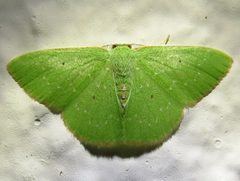
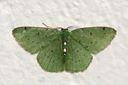
Synchlora herbaria is a small emerald moth in the Geometridae, first described by Johan Christian Fabricius in 1794. have a wingspan of approximately 13 mm. The is notable for its Caribbean distribution, with records from Florida and multiple Caribbean islands. Larvae have been documented feeding on camara, and like other Synchlora species, they camouflage themselves by attaching plant material to their bodies.
Pronunciation
How to pronounce Synchlora herbaria: /sɪnˈklɔːrə hɛrˈbɛəriə/
These audio files are automatically generated. While they are not always 100% accurate, they are a good starting point.
Identification
are distinguished from other emerald moths by their small size (13 mm wingspan) and geographic restriction to Florida and the Caribbean. From the widespread Synchlora aerata (Wavy-lined Emerald), which occurs across eastern North America, S. herbaria is separated by range—S. aerata does not occur in the Caribbean. The five recognized (herbaria, bonhotei, dorsuaria, intacta, sanctaecrucis) are distinguished by island locality. Larvae are identified by their habit of adorning their bodies with plant material and their presence on camara in the ' range.
Images
Appearance
are small emerald moths with a wingspan of about 13 mm. The "White-dotted Emerald" suggests green coloration with white spotting, typical of the . Larvae are known for their remarkable camouflage, covering their bodies with bits of plant material from their plants—specifically observed attaching spent anthers and other plant debris to their backs, rendering them nearly indistinguishable from their surroundings.
Habitat
and larvae are associated with supporting their plant camara, which includes disturbed areas, open fields, and forest edges in tropical and subtropical regions. The occurs in coastal and island environments throughout its Caribbean range.
Distribution
Florida (USA), Cuba, Hispaniola, Puerto Rico, the Bahamas, Antigua, Dominica, and the Virgin Islands. The distribution is restricted to the Caribbean Basin with a northern extension into peninsular Florida.
Diet
Larvae feed on camara (Verbenaceae). feeding habits are not documented.
Host Associations
- Lantana camara - larval food plantDocumented larval feeding record
Behavior
Larvae exhibit a distinctive camouflage : they attach bits of plant material—specifically spent anthers and other debris from their plant—to their bodies, making them appear as inanimate plant clusters. This behavior is shared with other Synchlora and represents a form of active substrate-matching .
Similar Taxa
- Synchlora aerataWidespread in eastern North America but not in Caribbean; larger range and different distribution pattern
- Other Synchlora species12 occur in North America; Caribbean distinguishes S. herbaria from mainland species
Sources and further reading
- BugGuide
- Wikipedia
- GBIF taxonomy match
- iNaturalist taxon
- NCBI Taxonomy
- Catalogue of Life
- UC Davis Art Show: Insects in the Anthropocene | Bug Squad
- The AI revolution in museums and herbaria
- Frustrating Emerald | Beetles In The Bush
- Community scientists digitized over a quarter-million items
- moths | Beetles In The Bush | Page 4
- October | 2012 | Beetles In The Bush