
Nemoria lixaria
(Guenée, 1857)
Red-bordered Emerald
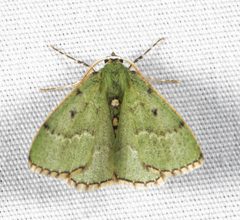
Nemoria lixaria, commonly known as the red-bordered emerald, is a small in the Geometridae. It is recognized by its bright green coloration and distinctive red marginal banding on the wings. The is widespread across North America and is frequently encountered by observers.
Pronunciation
How to pronounce Nemoria lixaria: /nɛˈmɔːr.iə lɪkˈsɛər.iə/
These audio files are automatically generated. While they are not always 100% accurate, they are a good starting point.
Identification
The combination of bright green wings with contrasting red borders distinguishes this from other North American emerald . Similar Nemoria species lack the distinct red marginal band or show different color patterns. The red-bordered emerald can be confused with other green geometrids, but the specific pattern of red restricted to the wing margins is diagnostic. Examination of genitalia may be required for definitive identification in some cases.
Images
Appearance
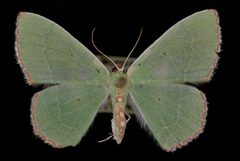
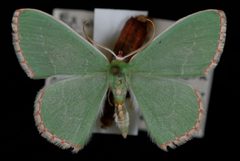
display bright emerald green wings with a prominent red or reddish-pink border along the outer margins of both forewings and hindwings. The wings are relatively broad and rounded, with a delicate, powdery scaling typical of emerald moths. Body is slender and green, matching the wing color. Wingspan approximately 20–25 mm.
Habitat
Deciduous and mixed forests, woodland edges, and areas with abundant oak vegetation. are frequently found in supporting their larval plants.
Distribution
North America, with records from the eastern United States west to Texas and north into southern Canada. Distribution appears to correspond with the range of oak .
Seasonality
are active primarily from late spring through summer, with peak activity typically in May through July depending on latitude. Multiple may occur in southern portions of the range.
Host Associations
- Quercus - larval Oak ; specific associations inferred from -level records for Nemoria
Behavior
are and attracted to light. They rest with wings spread flat or slightly folded, displaying the characteristic red-bordered pattern. Larvae are likely twig-mimics, a common trait in Nemoria , though this specific has not been directly documented for N. lixaria.
Ecological Role
Larvae function as herbivores on oak foliage, contributing to nutrient cycling in forest . serve as prey for including bats and birds.
Human Relevance
Occasionally encountered by enthusiasts and photographers due to its attractive coloration. No significant economic impact; not considered a pest .
Similar Taxa
- Nemoria bistriariaAlso green with red markings, but shows two red stripes across the wings rather than marginal borders
- Nemoria darwiniataGreen with variable markings but lacks the consistent red marginal band; more northern distribution
- Other GeometrinaeVarious green emerald moths lack the distinctive red-bordered wing pattern
More Details
Taxonomic note
Originally described as Racheospila lixaria by Guenée in 1857. The is well-represented in citizen science databases with over 5,000 observations on iNaturalist, indicating it is relatively common and conspicuous within its range.
MONA/Hodges number
7033