
Nepytia freemani
Munroe, 1963
Western False Hemlock Looper
Nepytia freemani is a geometrid known as the western false hemlock looper, described by Eugene G. Munroe in 1963. The has a one-year , as with larvae emerging in mid-May, feeding through summer, and pupating in late July. appear in August and September. The species has been documented reaching proportions, with a notable outbreak occurring in north central Utah from 1965 to 1967.

Pronunciation
How to pronounce Nepytia freemani: //nɛˈpɪtiə ˈfriːməni//
These audio files are automatically generated. While they are not always 100% accurate, they are a good starting point.
Identification
Distinguished from related Nepytia by geographic distribution and association with western conifer forests. The similar Nepytia janetae occurs in the southwestern U.S. (Arizona and New Mexico) and has been documented as a winter-feeding species at high elevations, whereas N. freemani is a summer feeder with flying August to October. N. freemani shows preference for white fir and Douglas-fir, while N. janetae feeds primarily on Engelmann spruce and corkbark fir in Arizona or acts as a conifer in New Mexico.
Images
Appearance
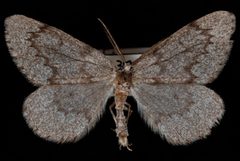
Wingspan approximately 21 mm. are small geometrid moths typical of the , with slender bodies and broad wings. Larvae are loopers (inchworms) with reduced , moving with characteristic looping gait.
Habitat
Coniferous forests, particularly those containing white fir and Douglas-fir. Understory vegetation present. Documented occurred in north central Utah in mixed conifer stands.
Distribution
North America: southern British Columbia, extreme southwestern Alberta, south through Washington, Idaho, Montana, and Utah. documented in north central Utah (1965-1967).
Seasonality
fly from August to October depending on location. Larvae emerge mid-May, feed through summer months, and begin late July. Overwinters in stage.
Diet
Larvae feed on conifers. White fir (Abies concolor) is the preferred ; Douglas-fir (Pseudotsuga menziesii) is also fed upon. During conditions with heavy defoliation, starved larvae have been observed feeding on ground vegetation in the understory.
Host Associations
- Abies concolor - preferred white fir
- Pseudotsuga menziesii - Douglas-fir
Life Cycle
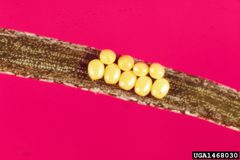
One-year . Overwinters as . Larvae emerge mid-May, feed during summer months, and begin in late July. appear in August. Females lay clusters of small oval eggs on both sides of needles.
Behavior
Larvae are wasteful feeders, destroying more needles than they consume. During conditions, heavy defoliation can cause topkill of trees. When resources are depleted, larvae will feed on understory ground vegetation.
Ecological Role
Defoliator of coniferous forests. Can reach proportions causing significant tree damage. Heavy has been documented but its effectiveness in is uncertain. outbreaks can lead to tree mortality through defoliation stress and subsequent bark beetle activity.
Human Relevance
Potential forest pest. Documented in Utah (1965-1967) caused heavy defoliation and topkill damage to white fir and Douglas-fir. Defoliation can predispose trees to bark beetle attack. No significant direct impact on humans otherwise documented.
Similar Taxa
- Nepytia janetaeSimilar conifer-feeding looper in southwestern U.S., but distinguished by winter-feeding larval at high elevations, geographic restriction to Arizona and New Mexico, and primary of Engelmann spruce and corkbark fir in Arizona versus conifer feeding in New Mexico. N. freemani is a summer feeder with broader western distribution.
More Details
Outbreak Dynamics
The 1965-1967 Utah represents the best-documented explosion for this . Despite heavy , the outbreak subsided in early 1967 with causes of decline remaining uncertain. This contrasts with N. janetae outbreaks in the Southwest, which ended primarily from , viruses, starvation, and weather factors.
Research Gaps
Much of the detailed biological information comes from a single study in Utah. The relationship between climate variables and outbreak initiation remains poorly understood, similar to the situation with related N. janetae.
Sources and further reading
- BugGuide
- Wikipedia
- GBIF taxonomy match
- iNaturalist taxon
- NCBI Taxonomy
- Catalogue of Life
- Nepytia janetae - Entomology Today
- Nepytia janetae defoliation - Entomology Today
- Nepytia janetae Archives - Entomology Today
- Why Has This Moth Turned Into a (Sometimes) Destructive Forest Pest?
- Ann Lynch, Ph.D. - Entomology Today
- ON THE OCCURRENCE AND BIOLOGY OF NEPYTIA FREEMANI (LEPIDOPTERA: GEOMETRIDAE) IN UTAH