
Macaria loricaria
(Eversmann, 1837)
False Bruce spanworm, Eversmann's peacock
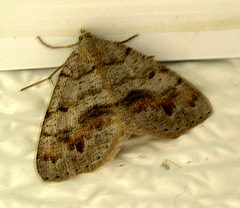
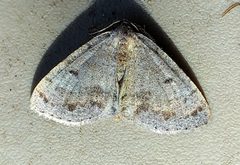
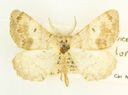
Macaria loricaria is a geometrid with pronounced : males are fully winged with a wingspan of 25–29 mm, while females are wingless. The has a broad transcontinental distribution spanning northern Eurasia from Fennoscandia to Sakhalin, and North America from Alaska to Newfoundland and south to Colorado. are active in mid-summer, with timing varying by region. The larvae feed on willow, birch, and aspen species.
Pronunciation
How to pronounce Macaria loricaria: /məˈkɛəriə lɔːˈrɪkəriə/
These audio files are automatically generated. While they are not always 100% accurate, they are a good starting point.
Identification
The wingless condition of females is diagnostic within the and rare among geometrid moths. Males may be distinguished from similar Macaria by a combination of size, wing pattern, and geographic range, though specific diagnostic characters require examination.
Images
Appearance
Males have fully developed wings with a wingspan of 25–29 mm; females are wingless (). Wing coloration and pattern details are not specified in available sources.
Habitat
Associated with plant stands: willow (Salix), birch (Betula), and trembling aspen (Populus tremuloides). Specific types (wetland, forest, etc.) are not documented.
Distribution
Transcontinental Holarctic. Eurasia: Fennoscandia, Baltic states, east to Sakhalin. North America: Alaska to Newfoundland and New York, south to Colorado. Presence confirmed in Norway, Sweden, Vermont (USA).
Seasonality
: mid July to August (Europe); late June to late July (North America). Larvae: May to July. Overwinters as .
Diet
Larvae feed on Salix , Betula species, and Populus tremuloides (trembling aspen) in North America.
Host Associations
- Salix - larval foodplantmultiple
- Betula - larval foodplantmultiple
- Populus tremuloides - larval foodplantNorth America only
Life Cycle
stage overwinters. Larvae present May–July. emerge mid-summer (timing varies by region).
Behavior
Females being wingless indicates limited capability; males presumably locate females via . Specific mating or oviposition are not documented.
Ecological Role
Larval herbivore on woody plants (Salix, Betula, Populus). Specific ecological impacts or are not documented.
Human Relevance
No documented economic or conservation significance. Occasionally encountered in entomological surveys and citizen science observations.
Similar Taxa
- Macaria bruceata (Bruce spanworm)Similar and plant associations; distinguished by winged females in M. bruceata versus wingless females in M. loricaria
More Details
Sexual dimorphism note
The extreme with wingless females is unusual in Geometridae and likely influences structure and .