
Macaria graphidaria
(Hulst, 1887)
Bold-marked Granite
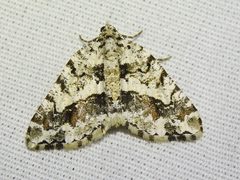
Macaria graphidaria is a North American in the Geometridae, described by George D. Hulst in 1887. display distinctive wing patterning with bold, dark markings on a lighter background. The species is associated with coniferous forests and has been documented across western North America. Larval stages feed on conifer foliage.
Pronunciation
How to pronounce Macaria graphidaria: //məˈkɛəriə ˌɡræfɪˈdɛəriə//
These audio files are automatically generated. While they are not always 100% accurate, they are a good starting point.
Identification
Distinguished from similar Macaria by the bold, well-defined dark markings on the forewings, particularly the pronounced band. Macaria signaria has more diffuse, less contrasting patterning. Macaria adonis typically shows more uniform gray coloration with fainter lines. Genitalia examination may be required for definitive identification of worn specimens.
Images
Habitat
Coniferous forests, particularly those dominated by Douglas-fir, ponderosa pine, and related Pinaceae. Occurs from low-elevation woodlands to montane forest zones. Associated with mature and second-growth stands.
Distribution
Western North America, from British Columbia and Alberta south through the Rocky Mountains to Arizona and New Mexico. Also documented in coastal California and the Pacific Northwest.
Seasonality
active primarily from May to August, with peak activity in June and July. Single-brooded in most of range; partial second possible in southern portions.
Diet
Larvae feed on foliage of conifers, particularly Pseudotsuga menziesii (Douglas-fir) and Pinus (pines).
Host Associations
- Pseudotsuga menziesii - larval food plantprimary
- Pinus - larval food plantsecondary , various
Life Cycle
Complete with four stages: , larva, pupa, . Eggs laid on foliage. Larvae feed externally on needles, developing through five instars. occurs in soil or leaf litter. stage uncertain, likely as pupa or late-instar larva.
Behavior
, attracted to light. Larvae solitary feeders, consuming needle tissue from conifer shoots. Not known to be gregarious.
Ecological Role
Herbivore in conifer forest . Larval feeding contributes to nutrient cycling and may influence needle turnover in dense . Serves as prey for forest-dwelling birds and .
Human Relevance
Minor forestry pest; occasional localized defoliation reported but rarely economically significant. Attracted to artificial light sources in forested residential areas.
Similar Taxa
- Macaria signariaOverlapping range and similar size, but with less contrasting wing pattern and fainter transverse lines
- Macaria adonisSimilar preference, but forewings more uniformly gray with reduced dark markings
- Macaria pustulariaComparable western distribution, distinguished by more mottled wing pattern with distinct spot
More Details
Taxonomic Notes
Originally described as Semiothisa graphidaria by Hulst (1887). Transferred to Macaria following revision of Geometridae classification. The epithet refers to the lined or written appearance of the wing pattern.