
Macaria aemulataria
Walker, 1861
Common Angle, common angle moth
Macaria aemulataria, the Common Angle, is a small geometrid with a wingspan of 20–22 mm. The is widespread across North America, ranging from Nova Scotia to Florida and west to Texas, Oregon, and Alberta. Larvae feed on maple species (Acer). are active from late spring through summer, with timing varying by latitude.
Pronunciation
How to pronounce Macaria aemulataria: /məˈkɛəriə ˌiːmjʊləˈtɛəriə/
These audio files are automatically generated. While they are not always 100% accurate, they are a good starting point.
Identification
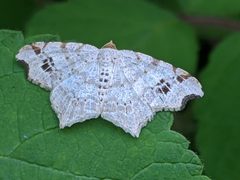
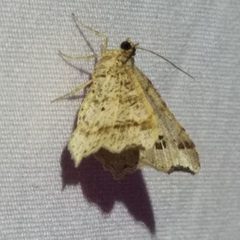
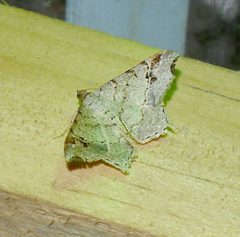
The angular forewing margin distinguishes this from most other Macaria. The pale gray-brown coloration with fine lines and small discal spot separates it from darker or more boldly patterned such as M. bisignata (the red-headed inchworm ), which has more contrasting markings and often reddish tones. Similar species with angular wings include M. pustularia, which has more prominent spotting and different wing shape.
Images
Appearance
Wingspan 20–22 mm. Forewings have a distinct angular or notched outer margin, giving the its . Ground color is pale gray to brownish with fine, darker transverse lines. A small dark discal spot is usually present. Hindwings are paler with less pronounced patterning. Body is slender and relatively small for the .
Habitat
Deciduous forests and woodlands, particularly areas with maple (Acer) plants. Found in both mature forests and suburban or park settings where maples are present. Elevation range spans sea level to at least moderate montane elevations in the western part of its range.
Distribution
Eastern and central North America: Nova Scotia south to Florida, west to Texas, north to Alberta, Oregon, and the Prairie Provinces. Records confirmed from Alberta, Manitoba, Saskatchewan (Canada) and Vermont (USA) among other provinces and states.
Seasonality
active mid-June to mid-July in Alberta; May to September in Ohio. period extends across summer months, with peak activity varying by latitude—earlier and more extended in the south, shorter and later in the north.
Diet
Larvae feed on Acer (maples). Specific Acer species documented as include sugar maple and likely other native and ornamental maple species.
Host Associations
- Acer - larval plantmaple
Life Cycle
Complete with , larval, pupal, and stages. Larvae are inchworms (typical of Geometridae) with reduced . stage not explicitly documented in sources but likely as pupa given patterns. Single or multiple per year depending on latitude; Ohio records suggest extended period possibly indicating partial second generation or extended .
Behavior
are and attracted to light. Larvae are foliage feeders on maple leaves, moving with characteristic looping gait of geometrid caterpillars.
Ecological Role
Larval herbivore on maple foliage; contributes to nutrient cycling in deciduous forest . Serves as prey for birds, , and other . Not considered a significant pest despite feeding on economically important trees.
Human Relevance
Occasional presence in urban and suburban areas due to widespread planting of ornamental maples. No significant economic impact; not a forestry pest. Sometimes encountered at porch lights and in surveys.
Similar Taxa
- Macaria bisignataRed-headed inchworm has more contrasting dark markings and often reddish tones; lacks the pale, uniform gray-brown appearance of M. aemulataria.
- Macaria pustulariaHas more prominent spotting and different wing shape despite also having somewhat angular forewings.
- Other Macaria speciesMost lack the distinctly angular forewing margin that characterizes M. aemulataria; many have straighter or more rounded wing edges.
More Details
Taxonomic note
Described by Francis Walker in 1861. The specific epithet 'aemulataria' refers to the emulative or imitative appearance, possibly alluding to resemblance to other . Placed in Ennominae within Geometridae.
Observation frequency
Well-represented in citizen science data with over 13,000 observations on iNaturalist, indicating it is frequently encountered and readily identifiable by enthusiasts.