
Biston betularia
(Linnaeus, 1758)
Peppered Moth
Biston betularia, the peppered , is a temperate night-flying geometrid moth native to Europe and northern Asia. The is renowned as a textbook example of industrial melanism, with two principal color morphs: the pale, speckled 'typica' form and the dark 'carbonaria' form. frequencies of these morphs have shifted historically in response to environmental changes, particularly industrial pollution affecting substrate coloration. The species has been introduced to North America.
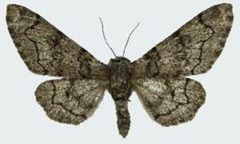

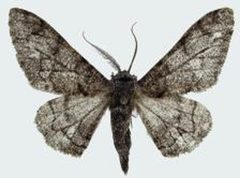
Pronunciation
How to pronounce Biston betularia: //ˈbɪstɒn bɛtʊˈlɑːriə//
These audio files are automatically generated. While they are not always 100% accurate, they are a good starting point.
Identification
Distinguished from similar geometrids by the distinctive peppered or melanic wing pattern combined with robust body shape. The 'typica' form resembles other cryptically patterned but is identified by the fine, dense speckling rather than bands or blotches. Dark 'carbonaria' individuals may be confused with other melanic moths but show characteristic white speckling when examined closely. Dissection of genitalia may be required for definitive identification in areas with similar .
Images
Appearance
Medium-sized with broad, triangular forewings. The 'typica' morph has white to pale gray wings densely peppered with small black speckles. The 'carbonaria' morph is predominantly black to dark brown with variable white speckling, ranging from nearly solid black to heavily spotted individuals. Intermediate 'insularia' morphs show a spectrum between these extremes. Wingspan approximately 45–55 mm.
Habitat
Woodlands, hedgerows, parks, and gardens; associated with trees and shrubs that provide resting substrates and larval food sources. Occurs in both rural and urban environments. Rests on tree trunks and branches during daylight hours.
Distribution
Native to Europe and northern Asia (excluding China). Present in Belgium, with records from Brussels-Capital Region and Flemish Region. Introduced to North America. In western Norway, found in coastal and inland localities near Bergen.
Seasonality
active from May to August in temperate regions; peak activity varies with latitude. Attracted to light traps at night.
Diet
Larvae feed on leaves of various deciduous trees and shrubs. Specific plants have been reported but require verification from primary sources.
Life Cycle
with one per year in most of its range. Overwinters as pupa. Laboratory rearing protocols have been established for maintaining annual husbandry cycles in captive .
Behavior
; fly at night and rest on tree trunks during daylight. Males are attracted to females via , enabling assembly trapping using laboratory-reared females. Resting site selection has been studied in relation to background color matching and avoidance.
Ecological Role
Larval herbivore on deciduous vegetation. Serves as prey for birds and other ; color morph frequencies influenced by differential pressure via visual selection.
Human Relevance
Classic example of and industrial melanism in evolutionary education. Subject of extensive research on genetics and environmental . Has inspired artistic and philosophical projects addressing environmental change.
Similar Taxa
- Other Biston speciesSimilar size and wing shape; require genitalia examination or molecular analysis for definitive separation
- Melanic forms of other geometrid mothsDark coloration convergent; B. betularia carbonaria distinguished by specific pattern of white speckling and association with known industrial melanism context
More Details
Industrial Melanism
The shift from predominantly pale 'typica' to dark 'carbonaria' forms during industrialization, and subsequent reversal with pollution reduction, remains one of the most cited cases of rapid evolutionary change. However, the precise mechanisms—whether primarily bird on mismatched backgrounds or additional factors—have been subject to ongoing research and debate.
Morph Frequency Variation
In western Norway, 85–95% of individuals are non-melanic typica. Where melanics occur, insularia predominates over carbonaria. Carbonaria frequencies of 2–5% are typical, with one locality reaching 9%. No clear geographic pattern of melanism was detected, and evidence for industrial melanism remains equivocal in this region despite localized pollution sources.
Sources and further reading
- BugGuide
- GBIF taxonomy match
- iNaturalist taxon
- NCBI Taxonomy
- Catalogue of Life
- Biston betularia protocols: Assembly trapping v1
- Biston betularia protocols: Rearing v1
- Biston betularia carbonaria Repopulating Maps with Climate Monsters
- Melanism in the Peppered Moth Biston betularia (L.) in western Norway (Lepidoptera: Geometridae)
- Behavioural studies on the peppered moth Biston betularia and a discussion of the role of pollution and lichens in industrial melanism