
Euchlaena muzaria
(Walker, 1860)
muzaria euchlaena moth
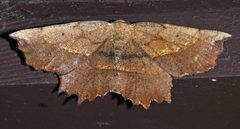
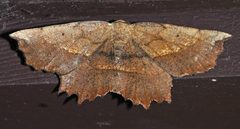
Euchlaena muzaria is a geometrid found in eastern North America. are active from April through August and are attracted to light. The is a feeder on black cherry and chokecherry during its larval stage. It occurs from Florida north to New Brunswick and west to Minnesota.
Pronunciation
How to pronounce Euchlaena muzaria: /juːˈkleɪ.nə muˈzɑr.i.ə/
These audio files are automatically generated. While they are not always 100% accurate, they are a good starting point.
Identification
Distinguished from other Euchlaena by forewing pattern with irregular, wavy transverse lines rather than more uniform or banded patterns. Euchlaena tigrinaria has more pronounced dark bands. Euchlaena amoenaria tends to be larger with more contrasting markings. Genitalia examination may be required for definitive identification of similar species.
Images
Habitat
Deciduous forest and woodland edges, particularly where plants (Prunus serotina and Prunus virginiana) occur. Also found in suburban and rural areas with cherry trees.
Distribution
Eastern North America: recorded from Florida, Kentucky, Maine, Maryland, Massachusetts, Minnesota, New Brunswick, New Hampshire, New York, North Carolina, Ohio, Ontario, South Carolina, Tennessee, and Vermont.
Seasonality
on wing from April to August. Peak activity varies by latitude; earlier in southern range, later in northern range.
Diet
Larvae feed on Prunus serotina (black cherry) and Prunus virginiana (chokecherry). feeding habits unknown.
Host Associations
- Prunus serotina - larval black cherry
- Prunus virginiana - larval chokecherry
Life Cycle
Complete . Larvae are inchworms that feed on cherry foliage. likely occurs in soil or leaf litter, though specific details not documented. stage not confirmed.
Behavior
are and attracted to artificial light sources. Larvae move with characteristic looping gait due to reduced number.
Ecological Role
Larval herbivore on native Prunus ; contributes to nutrient cycling through defoliation. Serves as prey for birds, , and other natural enemies.
Human Relevance
Occasional minor pest on ornamental cherry trees. Contributes to biodiversity in natural areas and serves as for healthy deciduous forest . Frequently encountered by citizen scientists during surveys.
Similar Taxa
- Euchlaena tigrinariaSimilar size and general appearance, but has more pronounced dark transverse bands on forewings rather than irregular wavy lines.
- Euchlaena amoenariaLarger on average with more contrasting light and dark markings; range overlaps but more common in southern Appalachians.
- Euchlaena irrariaForewing pattern tends toward more uniform gray with less distinct transverse lines.
More Details
Taxonomic History
Originally described as Endropia muzaria by Francis Walker in 1860; later transferred to Euchlaena.
Conservation Status
Not evaluated by IUCN; appears secure throughout range based on numerous observations across diverse .