
Plagodis alcoolaria
(Guenée, 1857)
Hollow-spotted Plagodis Moth, hollow-spotted plagodis
Plagodis alcoolaria is a geometrid native to eastern and central North America. are active from early spring through late summer, with two distinct seasonal forms. The exhibits seasonal , with spring and summer differing in coloration and pattern intensity. Larvae feed on deciduous trees, with documented preference for birch species.
Pronunciation
How to pronounce Plagodis alcoolaria: /ˈplaɡoˌdɪs ælˈkoʊˌlɛəriə/
These audio files are automatically generated. While they are not always 100% accurate, they are a good starting point.
Identification
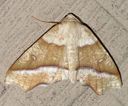
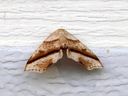
The outward-curved perimeter line meeting the nearer to the apex distinguishes this from other Plagodis. The large discal spot and yellowish-white ground color with orangish-brown shading are additional diagnostic features. Summer individuals are noticeably paler with fewer markings.
Images
Appearance
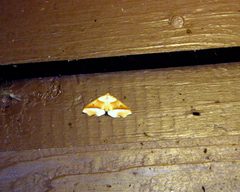
have yellowish-white wings with orangish-brown shading. Wing lines range from orange to brown-black. A prominent large discal spot is present. The perimeter line curves outward and meets the closer to the apex than in . Wingspan 26–35 mm. Summer individuals (historically treated as P. kempii) are paler yellow with reduced markings compared to the spring brood.
Habitat
Deciduous forest environments. Associated with tree presence, particularly birch stands.
Distribution
Eastern and central North America. Range extends from Nova Scotia and east-central Alberta south to Georgia, west to Manitoba, with scattered records in South Dakota, Missouri, and Mississippi.
Seasonality
active from late March through September. , with distinct spring and summer .
Diet
Larvae feed on leaves of various deciduous trees: basswood, beech, maple, oak, and birch. Preferential feeding on Betula (birch) has been observed.
Host Associations
- Betula - preferred larval birch
- Tilia - larval basswood
- Fagus - larval beech
- Acer - larval maple
- Quercus - larval oak
Life Cycle
with spring and summer . Larval development occurs on deciduous tree foliage. details not documented in available sources.
Ecological Role
Larval herbivore in deciduous forest . Contributes to nutrient cycling through leaf consumption.
Similar Taxa
- Plagodis phlogosariaSimilar wing pattern; distinguished by perimeter line meeting at different position
- Plagodis serinaria with overlapping range; differs in line curvature and discal spot characteristics
Misconceptions
The summer was historically described as a separate , P. kempii, but is now recognized as a seasonal form of P. alcoolaria.
More Details
Taxonomic History
Described by Achille Guenée in 1857. The summer was formerly treated as P. kempii before synonymization.
Polyphenism
One of the better-documented cases of seasonal in North American Geometridae, with spring and summer forms differing substantially in color intensity.