
Scythris limbella
(Fabricius, 1775)
Chenopodium Scythris Moth
Scythris limbella is a small in the Scythrididae, first described by Fabricius in 1775. It has a wingspan of approximately 15 mm. The is native to Europe and Asia, with established in the northeastern Nearctic region as an introduced species. are active from June to September, with larvae feeding on Chenopodium and Atriplex species.
Pronunciation
How to pronounce Scythris limbella: /ˈsɪθrɪs lɪmˈbɛlə/
These audio files are automatically generated. While they are not always 100% accurate, they are a good starting point.
Identification
The small size (15 mm wingspan) and association with Chenopodium or Atriplex plants in a silken web may aid identification. However, Scythrididae contains numerous similar-looking , many of which remain undescribed or poorly illustrated. Definitive identification requires examination of genitalia or molecular analysis. The species cannot be reliably distinguished from based on external appearance alone.
Images
Appearance
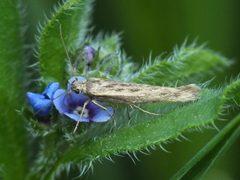
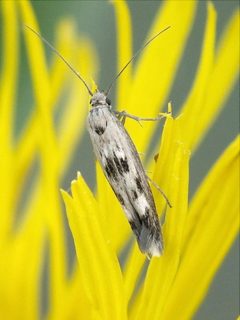
Small with wingspan approximately 15 mm. As a member of Scythrididae, likely have narrow, elongated wings and a slender body typical of microlepidopterans in this . Specific coloration and pattern details are not documented in available sources.
Habitat
Associated with supporting its larval plants, Chenopodium and Atriplex . These plants commonly occur in disturbed ground, agricultural fields, roadsides, and saline or alkaline soils. The has been observed on flowering shrubs in prairie environments in its introduced North American range.
Distribution
Native to most of Europe (absent from Iceland, Ireland, parts of the Balkan Peninsula, and Ukraine), extending east through Russia to Iran (Golestan to Fars provinces). Introduced and established in the northeastern Nearctic region (eastern North America).
Seasonality
are on wing from June to September. The period possibly represents two , though this requires confirmation.
Diet
Larvae feed on shoots and flowers of goosefoots (Chenopodium ) and orache (Atriplex species), constructing a silken web while feeding. feeding habits are not documented.
Host Associations
- Chenopodium - larval larvae feed on shoots and flowers
- Atriplex - larval larvae feed on shoots and flowers
Life Cycle
Larval stage feeds within a silken web on plant shoots and flowers. details are not documented. emerge June through September, with possible pattern.
Behavior
Larvae construct silken webs while feeding on plant reproductive structures. have been observed resting on flowers of composite shrubs. The is or in activity, as evidenced by daytime observations of adults on flowers.
Ecological Role
As a herbivore, larvae may influence seed production of Chenopodium and Atriplex . The species serves as prey for . Its introduced status in North America represents a novel interaction in that region.
Human Relevance
Minor potential as a pest of Chenopodium crops (including quinoa and related ). No significant economic impact documented. The species has been introduced to North America, likely through human-mediated transport.
Similar Taxa
- Scythris mixaulaSimilar size and appearance; however, S. mixaula is restricted to western North America and feeds on cactus (Cactaceae), not Chenopodium/Atriplex
- Other Scythris speciesNumerous are externally indistinguishable; many remain undescribed or await taxonomic revision. Identification to level requires genitalia dissection or
More Details
Taxonomic history
Originally described as Tinea limbella by Fabricius in 1775 before transfer to Scythris. The -level placement has been disputed: treated as Scythrididae by some authorities, or as Scythridinae within Xyloryctidae by others. Current consensus favors Scythrididae as a distinct family within Gelechioidea.
Conservation status
Not evaluated; appears to be widespread and locally common in native range, with expanding distribution in North America.