
Mompha locupletella
(Denis & Schiffermüller, 1775)
Red Cosmet
Mompha locupletella is a small microlepidopteran in the Momphidae. The is characterized by bright orange forewings with distinctive black, white, and silvery-grey markings. It is widely distributed across the Palearctic, with two per year in most of its range. The larvae are leaf-miners specialized on willowherbs (Epilobium species).
Pronunciation
How to pronounce Mompha locupletella: //ˈmɒmfə ˌlɒkjuːpləˈtɛlə//
These audio files are automatically generated. While they are not always 100% accurate, they are a good starting point.
Identification
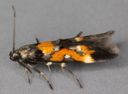
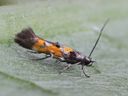
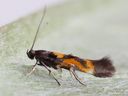
The bright orange forewing ground colour with white and silvery-grey markings distinguishes this from most other Mompha. It closely resembles Mompha terminella; separation requires examination of genitalia or careful comparison of wing pattern details. The combination of orange ground colour with specific arrangement of leaden-metallic and black markings is distinctive within its range.
Images
Appearance
Small with wingspan 9–12 mm. dark leaden-metallic. Female with white apex. Forewings bright orange ground colour, sometimes suffused with purple-brown; black basal blotch extended on , preceded and followed by leaden-metallic spots ( spot often connected to leaden-metallic black-edged spot on dorsum); wedge-shaped leaden-metallic black-edged mark along middle of costa; oblique leaden-metallic black-edged mark from dorsum before tornus; blackish patch preceded by whitish costal spot. Hindwings dark fuscous.
Habitat
Found in supporting plants, including meadows, marshes, and open woodland edges. Associated with both lowland and montane environments. In southern Europe, restricted to mountainous areas.
Distribution
Palearctic distribution: northern Europe; mountainous areas of central and southern Europe to north-western Spain; eastward to Zabaykalsky Krai and Kuril Islands in Russia. Present in Belgium (Flemish Region, Walloon Region, Brussels-Capital Region, Antwerpen province).
Seasonality
in most of range: first from second half of May to beginning of July; second generation adults from August to beginning of September. in northern parts of range only.
Diet
Larvae feed on Epilobium alpestre, Epilobium alsinifolium (chickweed willowherb), Epilobium lanceolatum (spear-leaved willowherb), Epilobium montanum (broad-leaved willowherb), Epilobium palustre (marsh willowherb), and Epilobium roseum.
Host Associations
- Epilobium alpestre - larval food plant
- Epilobium alsinifolium - larval food plantchickweed willowherb
- Epilobium lanceolatum - larval food plantspear-leaved willowherb
- Epilobium montanum - larval food plantbroad-leaved willowherb
- Epilobium palustre - larval food plantmarsh willowherb
- Epilobium roseum - larval food plant
Life Cycle
Larvae greyish-green with black and black plate of segment 2. Larvae mine in blotches in leaves of Epilobium . Larval periods: April to May (first ), July to beginning of August (second generation). Generally two generations per year, one in north.
Behavior
are or . Larvae are leaf-miners, feeding internally in blotches within leaves of plants.
Ecological Role
Leaf-miner on willowherbs; contributes to nutrient cycling through herbivory on Epilobium . Serves as prey for and other natural enemies.
Human Relevance
No significant economic or medical importance. Of interest to lepidopterists and naturalists. Recorded in citizen science platforms (iNaturalist).
Similar Taxa
- Mompha terminellaExtremely similar wing pattern; requires genitalia examination or detailed pattern comparison for reliable separation
More Details
Sexual dimorphism
Female distinguished by white apex; males lack this feature.