
Momphinae
mompha moths
Genus Guides
1Momphinae is a of small within Coleophoridae, historically treated as the separate Momphidae. The group comprises approximately 115 described , many of which remain poorly known. Larvae are concealed feeders with specialized habits: they function as leaf miners, seed borers, stem borers, gall inducers, or floral . associations are typically narrow, with many species specializing on particular plant families including Onagraceae and Melastomataceae.
Pronunciation
How to pronounce Momphinae: //mʌmˈfɪniː//
These audio files are automatically generated. While they are not always 100% accurate, they are a good starting point.
Identification
are small, nondescript requiring genitalia dissection for -level identification. Larvae are concealed feeders found within plant tissues (mines, seeds, stems, galls, or flower buds), distinguishing them from external-feeding caterpillars. using oxidase 1 sequences can assist identification when morphological characters are ambiguous or for larval specimens.
Images
Appearance
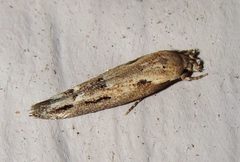
Small with wingspans up to 21 mm. Wings are held folded over the body at rest. are generally nondescript and require detailed morphological examination, including genitalia dissection, for reliable identification to .
Habitat
are defined by plant distribution. Includes coastal dune systems supporting Onagraceae hosts, dry rocky areas in Cerrado regions, and mountainous areas in eastern Brazil. Specific habitat varies by host association.
Distribution
Widespread distribution with documented records from North America (California coastal dunes), Central Brazil (Distrito Federal, Goiás, Minas Gerais), and presumably other regions where plants occur. Precise range limits for most remain undocumented due to poor taxonomic knowledge.
Diet
Larvae feed concealed within plant tissues: as leaf miners, within seeds, within stems, or on inner walls of self-induced galls. Some are floral feeding within flower buds. No external feeding has been observed.
Host Associations
- Camissoniopsis cheiranthifolia (Onagraceae) - floral larvae parasitize flower buds
- Tibouchina barbigera (Melastomataceae) - gall inducerstem galls
- Macairea radula (Melastomataceae) - gall inducerstem and leaf galls
- Macairea thyrsiflora (Melastomataceae) - gall inducerstem and leaf galls
- Henriettea succosa (Melastomataceae) - gall inducerstem galls
Life Cycle
laid on plant. Larva develops concealed within plant tissue—inside mines, seeds, stems, galls, or flower buds. occurs within the concealed feeding site; in gall-inducing , the pupa remains loose within the gall chamber without forming a cocoon. emerges through an sealed with white silk produced by the larva.
Behavior
Larvae induce galls on stems and leaves of plants, or parasitize flower buds. Larvae produce white silk to seal the gall prior to . are not described as having distinctive behavioral traits beyond typical activity patterns.
Ecological Role
herbivores with narrow associations. Gall-inducing contribute to the high of lepidopterous galls on Melastomataceae in Neotropical regions. Floral has been implicated in driving floral diversity evolution in host plants.
Human Relevance
No direct economic importance documented. Of scientific interest for studying plant-insect , particularly the role of specialized floral in promoting floral diversity. studies of Momphinae have demonstrated the utility of molecular methods for identifying concealed-feeding larvae that are morphologically difficult to identify.
Similar Taxa
- Coleophorinae (Coleophoridae)Sister within Coleophoridae; distinguished by larval case-bearing habit and different associations
- Other small microlepidopteran families (e.g., Elachistidae, Oecophoridae)Similar size and nondescript appearance; distinguished by genitalia and larval feeding habits
More Details
Taxonomic history
Momphinae was historically treated as the separate Momphidae. Current classification places it as a of Coleophoridae based on phylogenetic affinities.
Identification challenges
The group is diverse and poorly known, with most undescribed. Few barcode sequences exist in reference databases, limiting -based identification. Combined and morphological analysis is recommended for accurate identification.