
Coleotechnites gibsonella
(Kearfott, 1907)
common juniper leafminer
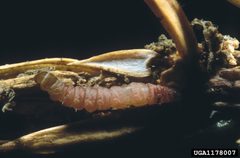
Coleotechnites gibsonella is a small gelechiid commonly known as the common juniper leafminer. It is restricted to northeastern North America where its larvae are specialized feeders on common juniper. The is notable for its distinctive larval of mining and binding juniper needles with silk to create protected feeding chambers.
Pronunciation
How to pronounce Coleotechnites gibsonella: //ˌkoʊ.li.oʊˈtɛk.nɪˌtiːz ˌɡɪb.səˈnɛl.ə//
These audio files are automatically generated. While they are not always 100% accurate, they are a good starting point.
Identification
Distinguished from other Coleotechnites by the combination of white forewings with three oblique dark brown bands and yellowish shading. The specific association with Juniperus communis and the characteristic needle-binding of larvae provide additional diagnostic cues. Similar gelechiid miners on juniper may differ in banding pattern, wing coloration, or larval feeding signs.
Images
Appearance
A small with wingspan approximately 11 mm. Forewings are white with yellowish shading at the apex and crossed by three oblique dark brown bands. Hindwings are yellowish-gray.
Habitat
Associated with stands of common juniper (Juniperus communis). Occupies both natural and semi-natural environments where this plant occurs, including open woodlands, rocky slopes, and old fields.
Distribution
Northeastern United States and Canada. Documented from Quebec (type locality: Hull, 1905), with additional records from Alberta and other Canadian provinces and US states in the Northeast.
Seasonality
One per year. active during summer months. Larvae present from summer through fall, in silk-lined chambers within bound needle bundles, resuming feeding on new terminal growth in spring.
Diet
Larvae feed exclusively on Juniperus communis. Young larvae mine or hollow the interior of needles at shoot ends. do not feed.
Host Associations
- Juniperus communis - obligate larval larvae mine needles and bind them with silk
Life Cycle
Holometabolous with one annually. laid on juniper foliage. Larvae feed through summer and fall, initially mining needle tips and binding dead needles with silk. In autumn, larvae construct silk-lined chambers within central needle bundles for . Spring prompts movement to new terminal growth with renewed silk-binding . presumably occurs in spring or early summer, though specific pupal site is not documented.
Behavior
Larvae exhibit distinctive silken architecture: binding hollowed needles together to form protective feeding shelters. This includes lining the center of needle bundles with silk to create chambers. The shows strong fidelity to terminal shoot growth, moving to new growth in spring after overwintering.
Ecological Role
As a specialized folivore on Juniperus communis, larvae function as a primary consumer in coniferous and mixed . Mining damage is localized to needle tips and typically limited in extent. The contributes to local biodiversity of gelechiid moths and serves as potential prey for and .
Human Relevance
Minor economic significance. Occasionally noticed as a pest in ornamental juniper plantings, though damage is generally cosmetic and limited. Of interest to lepidopterists due to its specialized and restricted range.
Similar Taxa
- Coleotechnites speciesOther share similar size, wing pattern elements, and juniper association; distinguished by specific forewing banding pattern and confirmed plant
- Other Gelechiidae on JuniperusMultiple gelechiids mine juniper needles; larval silk-binding and specific mine location (needle tips vs. bases) assist separation
More Details
Nomenclatural history
Originally described as Recurvaria gibsonella by Kearfott in 1907, based on material collected by Arthur Gibson in Hull, Quebec.
Type specimen
Collected in 1905 in Hull, Quebec by Arthur Gibson, who is honored in the specific epithet.