Gnorimoschema salinaris
Busck, 1911
Gnorimoschema salinaris is a small in the Gelechiidae, described by August Busck in 1911. It is found in eastern and central North America, with records from Florida to Maine and west to Illinois and Michigan. The is closely related to Gnorimoschema gallaesolidaginis, sharing similar wing patterns but differing in specific markings. Its larvae form galls on the stalks of seaside goldenrod (Solidago sempervirens).
Pronunciation
How to pronounce Gnorimoschema salinaris: /nɔːrɪmoʊˈskɛmə ˌsælɪˈnɛərɪs/
These audio files are automatically generated. While they are not always 100% accurate, they are a good starting point.
Identification
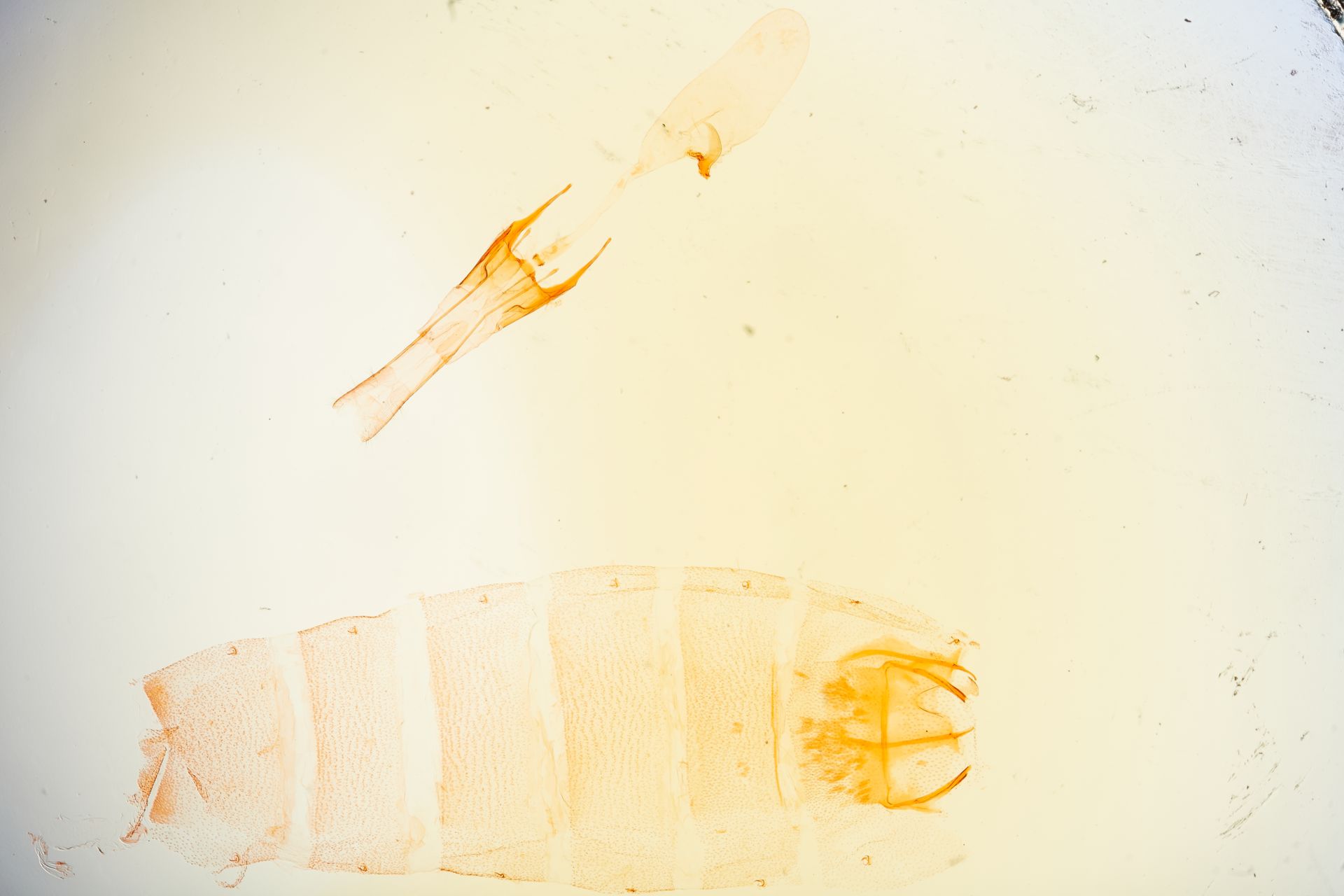
Distinguished from the very similar Gnorimoschema gallaesolidaginis by two key forewing characteristics: ill-defined blackish markings on the edge near the base, and irregular longitudinal blackish markings in the interior and portion of the dark costal area. G. gallaesolidaginis lacks these markings. Examination of genitalia may be required for definitive identification.
Images
Habitat
Coastal and near-coastal environments where the plant Solidago sempervirens (seaside goldenrod) occurs. This includes salt marshes, coastal dunes, and other saline-influenced .
Distribution
Eastern and central North America. Recorded from Florida, Illinois, Kentucky, Maine, Massachusetts, Michigan, and New York. Also reported from Alberta, Canada.
Diet
Larvae feed on Solidago sempervirens (seaside goldenrod), forming galls on the stalks.
Host Associations
- Solidago sempervirens - larval Larvae form galls on stalks
Life Cycle
Larval stage develops inside galls formed on stalks of the plant. emerge from galls. Specific details of , pupal stages, and number of per year are not documented.
Ecological Role
Gall-former on seaside goldenrod. The galls may accumulate soil contaminants at higher concentrations than surrounding plant tissues, based on research on related gall-forming insects.
Similar Taxa
- Gnorimoschema gallaesolidaginisExtremely similar forewing coloration and pattern; distinguished by absence of ill-defined blackish markings near base and absence of irregular longitudinal blackish markings in the interior and part of the dark costal area that are present in G. salinaris. Also differs in plant association, typically forming galls on Solidago canadensis and related goldenrod rather than S. sempervirens.
More Details
Type of gall
Forms galls on stalks of Solidago sempervirens, as opposed to the spherical or elongate stem galls formed by other goldenrod gall insects.
Research significance
Related in the Gnorimoschema have been subjects of research on phytoscreening—the use of plant galls to detect soil contaminants, as galls can accumulate pollutants at concentrations thousands of times higher than other plant tissues.
Sources and further reading
- BugGuide
- Wikipedia
- GBIF taxonomy match
- iNaturalist taxon
- Catalogue of Life
- Blacklighting at the Bohart: They Saw the Light | Bug Squad
- Meet 'The Moth Man' at Bohart Museum's Moth Night | Bug Squad
- Gnorimoschema gallaesolidaginis Archives - Entomology Today
- How Some Insects Turn Plants Into Pollution Detectors
- goldenrod gall - Entomology Today