
Gnorimoschema busckiella
Kearfott, 1903
Gnorimoschema busckiella is a small gelechiid described by William D. Kearfott in 1903. It is known from limited records in the northeastern and midwestern United States. The has a distinctive wing pattern created by an unusual arrangement that produces a bronze-brown color sprinkled with white. Its larvae feed on Aster patens, a species of aster native to eastern North America.
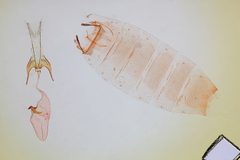
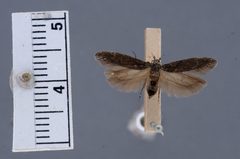
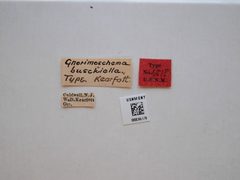
Pronunciation
How to pronounce Gnorimoschema busckiella: /nəˌɹiːmoʊˈskɛmə bʌsˈkiːɛlə/
These audio files are automatically generated. While they are not always 100% accurate, they are a good starting point.
Identification
The distinctive arrangement producing the bronze-brown and white irrorated pattern separates this from similar Gnorimoschema. The specific pattern of longer scales on the outer margins creating more exposed white is diagnostic. Specimens should be compared with other eastern North American Gnorimoschema, particularly those associated with Aster .
Images
Appearance
have a wingspan of 16–19 mm. The forewings are bronze brown with white irrorations (sprinkling). The color pattern results from a distinctive arrangement: the basal half of each scale is white, while the outer and overlapping half is bronze-brown. This arrangement is uniformly distributed across the wing except on the outer quarter of the costal margin and the outer margin, where longer scales expose more white and the colors appear nearly equal. On the outer margin, this coloration extends halfway out onto the cilia. The hindwings are fuscous (dusky gray-brown).
Habitat
Associated with supporting its plant Aster patens, which occurs in dry to moist open areas including meadows, fields, and woodland edges in eastern North America.
Distribution
Recorded from the US states of Maine, New Jersey, and Ohio. GBIF records additionally indicate presence in California and the United States broadly, though specific locality details are limited.
Diet
Larvae feed on Aster patens (spreading aster), a plant in the Asteraceae .
Host Associations
- Aster patens - larval food plant
Ecological Role
As a herbivore on Aster patens, the participates in plant-insect interactions within its native range. Its ecological role beyond larval herbivory has not been documented.
Human Relevance
No documented economic or medical significance. The is of interest to lepidopterists studying North American microlepidoptera and -plant relationships.
Similar Taxa
- Other Gnorimoschema speciesSimilar size and general appearance; distinguished by specific wing pattern and arrangement details, as well as plant association
More Details
Taxonomic history
Described by William D. Kearfott in 1903, with the specific epithet likely honoring entomologist August Busck, a prominent in North American microlepidoptera.
Research significance
The Gnorimoschema includes other notable such as G. gallaesolidaginis (goldenrod gall moth), which has been studied for its gall-forming and potential use in environmental monitoring. However, G. busckiella is not known to form galls.
Sources and further reading
- BugGuide
- Wikipedia
- GBIF taxonomy match
- iNaturalist taxon
- Catalogue of Life
- Blacklighting at the Bohart: They Saw the Light | Bug Squad
- Meet 'The Moth Man' at Bohart Museum's Moth Night | Bug Squad
- Gnorimoschema gallaesolidaginis Archives - Entomology Today
- How Some Insects Turn Plants Into Pollution Detectors
- goldenrod gall - Entomology Today