
Caryocolum pullatella
(Tengström, 1848)
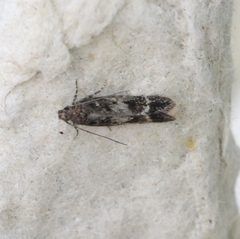
Caryocolum pullatella is a small gelechiid with a broad distribution spanning the Holarctic region. The is characterized by its small size, with forewings measuring 5–6.5 mm. are active from mid-May through mid-October, likely with a single . The species belongs to a whose larvae are specialized feeders on plants in the carnation (Caryophyllaceae).
Pronunciation
How to pronounce Caryocolum pullatella: /ˈkarjokoˌlum ˌpul.laˈtɛl.la/
These audio files are automatically generated. While they are not always 100% accurate, they are a good starting point.
Identification
Small forewing length (5–6.5 mm) distinguishes Caryocolum pullatella from larger . Precise identification from related Caryocolum requires examination of genitalia or molecular analysis, as external is often similar within the . The species has been historically confused with related , as demonstrated by the recent revision of the C. schleichi species group which revealed multiple cryptic species.
Images
Appearance
Small with forewings 5–6.5 mm in length. Wing pattern and coloration details are not explicitly documented in available sources.
Habitat
Dry and sunny . Specific habitat preferences for C. pullatella are not separately documented from , though related in the inhabit alpine and subalpine environments up to 2,500 m elevation.
Distribution
Europe: Austria, Italy, Denmark, Poland, Estonia, Latvia, Norway, Sweden, Finland, Ukraine, Russia. Asia: Japan. North America: Canada (Alberta, Manitoba, and additional provinces), United States (northern states, south to Arizona in the west), Alaska.
Seasonality
recorded on wing from mid-May to mid-October. Probably one per year.
Life Cycle
Larval unknown for this . Related Caryocolum species have larvae that feed exclusively on Caryophyllaceae (carnation ), with stone carnations (Petrorhagia spp. or related ) as likely for alpine species.
Behavior
have been observed at artificial light at night. No other behavioral details are documented.
Ecological Role
As a member of a specialized on Caryophyllaceae, larvae likely function as herbivores on their plants. No specific ecological role has been documented for this .
Human Relevance
No direct human relevance documented. The has been used as an example in studies demonstrating the of undescribed cryptic diversity in well-studied European regions.
Similar Taxa
- Caryocolum schleichi species groupHistorically confused with C. pullatella; recent integrative taxonomic revision using molecular methods revealed multiple cryptic within this complex, including C. messneri, C. habeleri, and C. lamai.
- Other Caryocolum speciesExternal is often similar; reliable separation requires genitalia examination or .
More Details
Taxonomic history
Originally described as Gelechia pullatella by Tengström in 1848, later transferred to Caryocolum. The exemplifies challenges in gelechiid , where morphologically similar species have been revealed through molecular studies.
Research significance
The C. schleichi group revision demonstrated that even in well-studied European regions like the Alps, cryptic remains underestimated, with implications for conservation .