
Mirificarma eburnella
(Denis & Schiffermüller, 1775)
Mirificarma eburnella is a small gelechiid with a Palearctic distribution, now established in California as an introduced . It is associated with leguminous plants and has been studied as a potential agent for clovers. are active in spring and early summer.
Pronunciation
How to pronounce Mirificarma eburnella: /ˌmɪrɪfɪˈkɑːmə ˌiːbərˈnɛlə/
These audio files are automatically generated. While they are not always 100% accurate, they are a good starting point.
Identification
Distinguished from other Mirificarma by genitalia ; external identification requires examination of wing pattern details and association with known plants. The cream-colored and small size are consistent with the but not diagnostic alone.
Images
Appearance
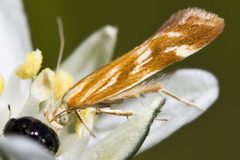
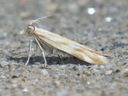
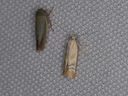
Very small with wingspan of 5–7.5 mm in males and 5.5–7.5 mm in females. cream-colored. Forewings narrow, with pattern typical of the .
Habitat
Found in open supporting leguminous vegetation, including grasslands, meadows, agricultural fields, and disturbed areas where clovers and medicks grow.
Distribution
Native to western, central, and southern Europe; extends east to Russia and south to North Africa and the Middle East. Introduced and established in California, United States.
Seasonality
active March–July in Europe; May–June in North America. Larvae present April–May.
Diet
Larvae feed on Medicago sativa (alfalfa), Medicago lupulina (black medick), Medicago polymorpha (bur clover), Trifolium repens (white clover), Trifolium hirtum (rose clover), Vicia americana (American vetch), and Hippocrepis comosa (horseshoe vetch).
Host Associations
- Medicago sativa - larval agricultural crop
- Medicago lupulina - larval
- Medicago polymorpha - larval
- Trifolium repens - larval widespread lawn and pasture
- Trifolium hirtum - larval
- Vicia americana - larval North American native
- Hippocrepis comosa - larval
Life Cycle
Larvae found in April and May; and follow. Specific pupal and stage not documented in available sources.
Behavior
Larvae are leaf-feeders on plants. activity presumed based on characteristics, though not explicitly documented.
Ecological Role
Herbivore specializing on Fabaceae; may contribute to of weedy clovers in managed landscapes.
Human Relevance
Evaluated as a potential agent for clovers in California. Not known to cause significant economic damage to cultivated legumes.
Similar Taxa
- Other Mirificarma speciesSimilar size and general appearance; require genitalia dissection or molecular analysis for definitive identification.
- Other small GelechiidaeOverlap in size and ; distinguished by plant association and detailed wing venation/pattern.
More Details
Introduction History
The California is presumed to have been introduced, likely via agricultural or horticultural trade, though the exact and date remain undocumented.
Biological Control Research
Has been investigated for control of rose clover (Trifolium hirtum) and other weedy legumes in California grasslands.