
Athrips
Billberg, 1820
Species Guides
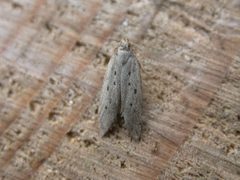
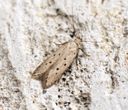
1- Athrips mouffetella(Ten-spotted Honeysuckle Moth)
Athrips is a of small in the Gelechiidae containing approximately 60 described distributed across the Palaearctic and Afrotropical regions. Species are organized into species-groups based on morphological and presumably phylogenetic relationships, with the largest diversity centered in arid and semi-arid regions of Central Asia. The genus was revised taxonomically in 2005 for the Palaearctic region, with subsequent revisions for China (2009) and Africa (2010). One species, A. mouffetella, has been -sequenced as part of the Darwin Tree of Life Project.
Pronunciation
How to pronounce Athrips: /ˈæθrɪps/
These audio files are automatically generated. While they are not always 100% accurate, they are a good starting point.
Identification
Athrips are small gelechiid moths, generally with forewing lengths of 7–8.5 mm or less. Identification to species level typically requires examination of genitalia ; male and female genitalia structures are diagnostic and have been illustrated in taxonomic revisions. Species-groups within the are distinguished by combinations of wing pattern, genitalia structure, and geographic distribution. The genus Parapsectris was synonymized with Athrips in 2010 based on genitalia similarities.
Images
Habitat
varies by and region. The type species A. mouffetella occupies deciduous woodland in Europe, with larvae feeding on terminal leaves of honeysuckle and snowberry. Many Central Asian species occur in steppe and desert habitats, reflected in species-group names (stepposa, tsaidamica). Afrotropical species have been collected from savanna and woodland habitats in Kenya, Tanzania, and South Africa.
Distribution
Widespread across the Palaearctic region from Europe through Central Asia to the Russian Far East; significant diversity in China and Mongolia. Afrotropical distribution includes Kenya, Tanzania, South Africa, with records from savanna and woodland zones. A. mouffetella has been accidentally introduced to North America. GBIF records indicate presence in Scandinavia (Denmark, Norway, Sweden) and northeastern North America (Vermont, USA).
Seasonality
A. mouffetella is single-brooded with flying June to early September. Seasonality of other is poorly documented; some Central Asian species likely have or cycles adapted to arid climates.
Diet
Larvae of A. mouffetella feed on terminal leaves of honeysuckle (Lonicera) and snowberry (Symphoricarpos). Larval diet of other Athrips is largely unknown; no plant records are established for the majority of described species.
Host Associations
- Lonicera - larval food planthoneysuckle; terminal leaves fed upon by A. mouffetella larvae
- Symphoricarpos - larval food plantsnowberry; terminal leaves fed upon by A. mouffetella larvae
Life Cycle
A. mouffetella: single-brooded, larvae spin silken webs on terminal leaves of plants. Larvae are dark purplish-black or grey with white spots behind the and along the body side, distinguishing them from other web-spinning larvae. details for other are not documented.
Behavior
A. mouffetella are readily attracted to light. Larvae construct silken webs on terminal leaves of plants. Behavioral information for other is unavailable.
Human Relevance
A. mouffetella sequenced (869.7 Mb, 31 chromosomal pseudomolecules, 22,889 protein-coding genes) as part of the Darwin Tree of Life Project, providing genomic resources for gelechiid phylogenomics. No economic importance established for the .
Similar Taxa
- ParapsectrisSynonymized with Athrips in 2010; previously recognized as distinct but genitalia demonstrated congeneric status
- Other Gelechiidae generaAthrips distinguished by combination of small size, specific genitalia (detailed in taxonomic revisions), and in some -groups by characteristic wing pattern elements
More Details
Taxonomic history
The was established by Billberg in 1820. Major revisions include Bidzilya (2005) for the Palaearctic region (recognizing 13 -groups), Bidzilya & Li (2009) for China, and Bidzilya (2010) for Africa which synonymized Parapsectris and described numerous new species. Species-group structure reflects morphological clusters but phylogenetic relationships remain largely untested.
Genomic resources
Athrips mouffetella (Linnaeus, 1758) was sequenced from a specimen collected at Wytham Woods, Oxfordshire, UK. assembly: 869.7 Mb scaffolded into 29 plus Z and W ; 22,889 protein-coding genes annotated.