
Athrips mouffetella
(Linnaeus, 1758)
Ten-spotted Honeysuckle Moth, Dotted Grey Groundling
Athrips mouffetella is a small gelechiid known by two reflecting its appearance and association. fly from June to early September and are readily attracted to light. The has a broad Palearctic distribution and has been introduced to North America. Its larvae feed exclusively on honeysuckle and snowberry, spinning silken webs on terminal leaves.
Pronunciation
How to pronounce Athrips mouffetella: /ˈæθrɪps muːfəˈtɛlə/
These audio files are automatically generated. While they are not always 100% accurate, they are a good starting point.
Identification
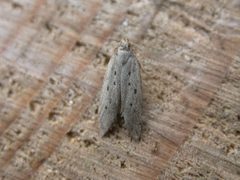
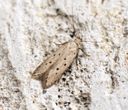
Distinguished from similar Athrips by the specific arrangement of five black spots on the forewing: two stigmata with the first discal positioned beyond the plical, plus an additional dot obliquely beneath and before the second discal. The rosy-tinged, silvery grey forewing coloration and small size (forewing 7–8.5 mm) help separate it from larger or differently patterned . Larvae are identified by dark purplish-black or grey coloration with white spots behind the and along the body side, brighter on the and faded on subsequent segments.
Images
Appearance
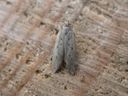
Small with forewing length 7–8.5 mm and wingspan approximately 15 mm. Forewings are light ashy brown with paler, faintly rosy-tinged irroration and silvery grey overall appearance. Five black spots present: two minute dots near the base, two stigmata (first discal beyond the plical), and one dot obliquely beneath and before the second discal. Additional minute black dots occur on the termen. Hindwings are grey. Larva is blackish-grey with a whitish line on incisions between segments 2 and 4; indistinct whitish spiracular line, clearer anteriorly; and plate of segment 2 black.
Habitat
Found in woodland edges, hedgerows, and gardens where plants (Lonicera and Symphoricarpos albus) occur. Common but local in England and Wales; collection records include deciduous woodland such as Wytham Woods, Oxfordshire.
Distribution
Native range extends from central and northern Europe across the Ural Mountains to Siberia and the Russian Far East. Present throughout Europe excluding the Iberian Peninsula; isolated records extend to far eastern Asia. Introduced to North America (accidental introduction). In the British Isles, common but local in England and Wales with a single record from Scotland.
Seasonality
Single-brooded (). fly from June to August, with some records extending to early September depending on location. Larval stage occurs prior to adult .
Diet
Larvae feed on terminal leaves of honeysuckle (Lonicera periclymenum, Lonicera xylosteum, Lonicera caprifolium) and snowberry (Symphoricarpos albus). feeding habits not documented.
Host Associations
- Lonicera periclymenum - larval food plantcommon honeysuckle
- Lonicera xylosteum - larval food plantfly honeysuckle
- Lonicera caprifolium - larval food plantItalian woodbine
- Symphoricarpos albus - larval food plantcommon snowberry
Life Cycle
Single per year. Larvae feed on plant leaves, spinning silken webs on terminal foliage. presumably occurs in the larval web or nearby detritus, though pupal details are not explicitly documented. emerge June to early September.
Behavior
are readily attracted to light. Larvae spin silken webs on terminal leaves of plants while feeding. activity during summer months.
Ecological Role
Herbivore; larvae function as folivores on Caprifoliaceae, potentially contributing to localized defoliation of shrubs. No other roles documented.
Human Relevance
sequenced as part of the Darwin Tree of Life Project (Wellcome Sanger Institute), providing a 869.7 Mb assembly with 31 chromosomal pseudomolecules and 22,889 protein-coding genes. Occasionally encountered by enthusiasts at light traps. Not considered an agricultural or forestry pest.
Similar Taxa
- Other Athrips speciesSimilar size and general appearance, but distinguished by forewing spot pattern and arrangement of stigmata relative to plical
- Other Gelechiidae with spotted forewingsA. mouffetella specifically associated with honeysuckle and snowberry ; larval host plant and larval coloration (dark with white spots) provide additional separation
More Details
Genomic Resources
Reference available from Darwin Tree of Life Project: 869.7 Mb assembly, 31 chromosomal pseudomolecules (29 + ZW ), 22,889 protein-coding genes. Female specimen from Wytham Woods, Oxfordshire, UK sequenced.
Etymology
Specific epithet 'mouffetella' derived from Latin; original basionym Phalaena mouffetella established by Linnaeus in 1758.