
Dichomeris nonstrigella
(Chambers, 1878)
Little Devil Moth, little devil
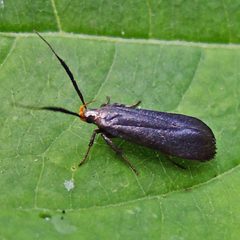
Dichomeris nonstrigella, commonly known as the Little Devil , is a small gelechiid moth described by V.T. Chambers in 1878. It occurs across eastern and central North America, with active in late spring and early summer. The is notable for its specialized larval association with a single plant .
Pronunciation
How to pronounce Dichomeris nonstrigella: /daɪˈkoʊmərɪs nɒnstrɪˈɡɛlə/
These audio files are automatically generated. While they are not always 100% accurate, they are a good starting point.
Identification
The can be identified by its small size (forewings 7–9 mm), geographic range in eastern North America, and period from May to July. It may be distinguished from similar Dichomeris species by plant association with Aster shortii, though genitalia examination is likely necessary for definitive identification.
Images
Appearance
Small with forewings measuring 7–9 mm in length. As a member of Gelechiidae, it possesses narrow, forewings and relatively broad hindwings. Specific coloration and pattern details are not documented in available sources.
Habitat
Associated with supporting its larval plant Aster shortii, which occurs in dry to mesic prairies, open woodlands, and rocky slopes. Specific habitat preferences for the stage are not documented.
Distribution
Recorded from Nova Scotia south to Maryland, west to Michigan, Kansas, Arkansas, and Kentucky. Additional records from Vermont and Canada (GBIF). The appears to be broadly distributed across eastern and central North America.
Seasonality
are on wing from May to July, with peak activity during late spring and early summer.
Diet
Larvae feed on Aster shortii (Short's aster), a plant in the Asteraceae . feeding habits are not documented.
Host Associations
- Aster shortii - larval food plantRequired for larval development
Life Cycle
Complete with , larval, pupal, and stages. Larvae develop on Aster shortii. Specific details regarding site, stage, and number of per year are not documented.
Ecological Role
Functions as a herbivore on Aster shortii, potentially contributing to of this plant . May serve as prey for insectivorous birds, bats, and other arthropods.
Human Relevance
No documented economic or agricultural significance. Occasionally encountered by naturalists and enthusiasts.
Similar Taxa
- Dichomeris spp.Numerous congeneric in North America with similar size and general ; accurate identification typically requires examination of genitalia or plant association
- Other Gelechiidae members share narrow forewings and small size; separation requires detailed morphological study
More Details
Original description
First described as Dasycera nonstrigella by Vactor Tousey Chambers in 1878, later transferred to Dichomeris
Nomenclatural note
Basionym: Dasycera nonstrigella Chambers, 1878