
Dichomeris inserrata
(Walsingham, 1882)
Indented Dichomeris Moth
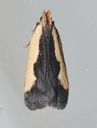
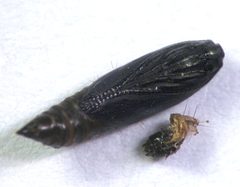
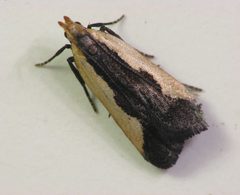
Dichomeris inserrata, commonly known as the Indented Dichomeris , is a small gelechiid moth native to the United States. are characterized by a wingspan of 5.4–8.3 mm. The is associated with goldenrod as a larval plant. It has been documented across multiple eastern and central U.S. states.
Pronunciation
How to pronounce Dichomeris inserrata: //daɪˈkoʊ.mɛrɪs ɪnsəˈreɪtə//
These audio files are automatically generated. While they are not always 100% accurate, they are a good starting point.
Identification
The can be identified by its very small size (wingspan under 9 mm) and association with goldenrod . The specific epithet "inserrata" (indented) may refer to subtle wing margin characteristics, though diagnostic features distinguishing it from congeneric species are not detailed in available literature. Dissection of genitalia is typically required for definitive identification within Dichomeris.
Images
Appearance
A minute with wingspan 5.4–8.3 mm. Specific coloration and pattern details are not documented in available sources.
Habitat
Associated with goldenrod (Solidago spp.) stands, suggesting open fields, meadows, and disturbed areas where this plant occurs. Specific microhabitat preferences for are not documented.
Distribution
Documented from the United States, specifically: New Jersey, Missouri, Pennsylvania, Florida, and Vermont. Additional records indicate presence in Canada, though specific provinces are not confirmed in available sources.
Diet
Larvae feed on goldenrod (Solidago spp.). feeding habits are not documented.
Host Associations
- Solidago - larval Goldenrod
Ecological Role
Larval herbivore on goldenrod; specific ecological impacts or interactions are not documented.
Similar Taxa
- Other Dichomeris speciesNumerous congeneric share small size and general gelechiid ; reliable identification requires examination of genitalia or molecular analysis.
More Details
Nomenclature
Originally described as Gelechia inserrata by Walsingham in 1882; later transferred to Dichomeris.
Observation frequency
The has accumulated over 600 observations on iNaturalist, suggesting it is not rare within its range, though it may be undercollected due to its minute size.