
Nealyda kinzelella
Busck, 1900
Nealyda kinzelella is a minute gelechiid described by August Busck in 1900, named in honor of botanist F. Kinzel. The is known only from Florida and is distinguished by its striking forewing pattern of light brown basal, dark velvety , and silvery-white regions. The larvae are leaf miners on Guapira obtusata, forming distinctive trumpet-shaped blotch mines on the upper leaf surface.
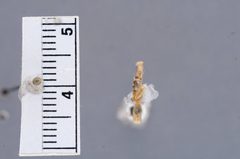
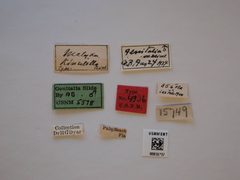
Pronunciation
How to pronounce Nealyda kinzelella: /niːˈælɪdə kɪnˈzɛlə/
These audio files are automatically generated. While they are not always 100% accurate, they are a good starting point.
Identification
Distinguished from other Nealyda by the combination of small size (5.5–6.5 mm wingspan), the pronounced tooth on the transverse forewing fascia, and the silvery-white forewing half with heavy black, fuscous, and bluish scaling. The trumpet-shaped leaf mines on Guapira obtusata are diagnostic for larvae.
Images
Habitat
Associated with plant Guapira obtusata; specific requirements beyond host presence are undocumented.
Distribution
Recorded from Florida, United States. GBIF records confirm US distribution only.
Diet
Larvae feed on Guapira obtusata (Nyctaginaceae). feeding habits are unknown.
Host Associations
- Guapira obtusata - larval Larvae mine leaves of this plant
Life Cycle
Larvae mine leaves of Guapira obtusata, creating upper surface trumpet-formed blotch mines. occurs outside the mine in a snow white cocoon. Other life stages are undescribed.
Behavior
Larvae are leaf miners. are presumably given tendencies, though direct observations are lacking.
Ecological Role
As a , larvae may influence leaf physiology and nutrient cycling of the plant Guapira obtusata; -level ecological effects are unknown.
Human Relevance
Named in honor of botanist F. Kinzel. No known economic or conservation significance.
Similar Taxa
- Other Nealyda speciesSimilar small size and gelechiid wing shape; distinguished by the unique forewing color pattern and tooth structure described for N. kinzelella
More Details
Etymology
The epithet kinzelella honors botanist Mr. F. Kinzel.
Taxonomic history
Described by August Busck in 1900; remains in original placement.