
Aristotelia
twirler moths
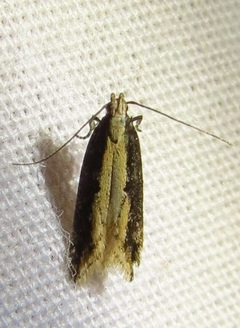
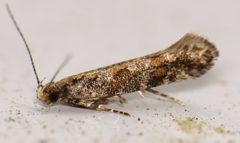
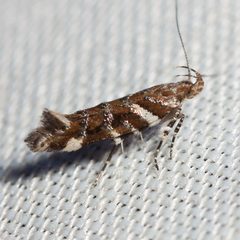
Aristotelia is a of small in the Gelechiidae, commonly known as twirler moths. These microlepidoptera are characterized by their tiny size yet bold, -looking markings. The genus contains approximately 35 named in North America north of Mexico, with many additional species awaiting formal description. Aristotelia moths are attracted to blacklights and are frequently encountered during insect surveys. Each species specializes on a particular plant, though collectively the genus utilizes many plant families.
Pronunciation
How to pronounce Aristotelia: //ˌæ.rə.stəˈtiːl.jə spɛkˈsɪks ɛl//
These audio files are automatically generated. While they are not always 100% accurate, they are a good starting point.
Identification
Aristotelia are tiny , typically under 15 millimeters in length, with distinctive bold color patterns that appear relative to their minute size. They are classified in the twirler moth Gelechiidae, whose members often rest with wings wrapped tightly around the body. Positive identification to species level requires examination of microscopic characters including genitalia, as external is often insufficient for distinguishing closely related species.
Images
Habitat
Found in diverse including dry mixed conifer forest with oaks, wooded areas with cliffs, and areas with landscape trees, shrubs, and plants. The presence of plants is the primary habitat determinant, with each associated with particular plant .
Distribution
occurs in North America with documented records from Colorado (Lyons, Colorado Springs), New Mexico (Pinos Altos, Grant County), and presumably throughout western North America. The 35+ named north of Mexico collectively span diverse geographic regions.
Seasonality
are active during summer months, with records from July in Colorado and August in New Mexico. Activity is , with adults attracted to ultraviolet lights after sunset.
Diet
Larvae feed on specific plants, with each Aristotelia specializing on a particular plant species or . Collectively, caterpillars utilize many of plants, though specific host records for individual species are often poorly documented.
Life Cycle
Complete with , larval, pupal, and stages. Larvae are specialized feeders on plants. likely occurs in concealed locations on or near the host plant. Adults emerge in summer and are , flying to lights.
Behavior
are strongly attracted to blacklights and ultraviolet light sources, making them readily detectable during insect surveys. They are active after sunset and often fly in cool, damp conditions.
Ecological Role
Larvae function as herbivores on their plants, contributing to nutrient cycling and serving as food sources for and . serve as prey for and may contribute to pollination in limited capacity.
Human Relevance
Primarily of interest to entomologists, enthusiasts, and ecologists conducting biodiversity surveys. Frequently documented during National Moth Week events and citizen science initiatives using iNaturalist. No significant economic importance documented.
Similar Taxa
- Ethmia (Depressariidae)Both are boldly patterned microlepidoptera attracted to lights, but Ethmia are larger (10-15 mm), exhibit uniform black, white, and gray coloration, and have different larval plant associations (Boraginaceae, Ehretiaceae, Hydrophyllaceae).
- Argyresthia (Argyresthiidae)Similar tiny size (3.2-6.8 mm) and metallic markings, but Argyresthia are typically white with broad transverse metallic stripes and are miners of conifer needles or broadleaved plants rather than external feeders.
- Ypsolophidae/PlutellidaeSimilar small size (6-13 mm) and forward-projecting often banded , but these construct loose silk webs on plants and have different resting postures.
More Details
Taxonomic Uncertainty
The specific epithet 'sp-six-sl' in the provided name suggests this is an undescribed or provisionally identified , possibly the sixth species in a series of similar taxa or a specimen code from a survey. Many Aristotelia species remain undescribed, making precise identification challenging without dissection and comparison to .
Citizen Science Documentation
Aristotelia specimens have been documented during organized -watching events, including National Moth Week activities sponsored by the Mile High Club in Colorado. Observations are frequently posted to iNaturalist, contributing to understanding of distribution and .