
Aristotelia monilella
Barnes & Busck, 1920
Aristotelia monilella is a micro- in the Gelechiidae, described by Barnes and Busck in 1920. It is a small with a wingspan of 12–13 mm, characterized by distinctive white markings on golden-brown forewings. The species has been recorded from Illinois, Kentucky, North Carolina, and Florida.
Pronunciation
How to pronounce Aristotelia monilella: /ˌæɹɪstoʊˈtiːliə ˌmoʊnɪˈlɛlə/
These audio files are automatically generated. While they are not always 100% accurate, they are a good starting point.
Identification
Distinguished from other Aristotelia by the specific pattern of three white marginal spots on the forewing—particularly the equilateral triangular spot at the middle of the and the inwardly directed triangular spot at the fourth. The continuation of white spots across the wing by black and metallic-blue , terminating in small white spots, is diagnostic. The broadly velvety black apical and terminal edges with metallic-blue scale tufts further separate it from .
Images
Appearance
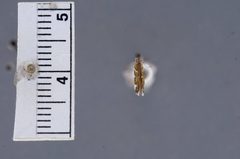
Small with wingspan of 12–13 mm. Forewings light golden brown with three prominent white marginal spots: an outwardly oblique transverse streak at the basal fourth (attenuated toward dorsum, not reaching edge), an equilateral triangular spot at middle of , and an inwardly directed triangular spot at fourth. White spots continued across wing by black and metallic-blue , terminating in small white spots on edge. Apical and terminal edges broadly velvety black with conspicuous tufts of metallic-blue scales around margin.
Distribution
North America: recorded from Illinois, Kentucky, North Carolina, and Florida.
Similar Taxa
- Other Aristotelia speciesShare and general 'twirler moth' , but differ in specific forewing spot patterns and coloration details
- Other GelechiidaeSimilar small size and wing shape, but A. monilella distinguished by its distinctive white, black, and metallic-blue forewing pattern
More Details
Etymology
Specific epithet 'monilella' likely derived from Latin 'monile' (necklace or collar), possibly referring to the necklace-like pattern of spots and markings on the forewings.
Taxonomic history
Described by William Barnes and August Busck in 1920, two prominent North American lepidopterists of the early 20th century.