
Elachista subalbidella
Schläger, 1847
buff grass-miner
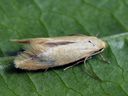
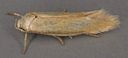
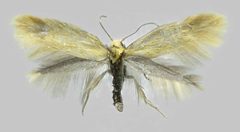
Elachista subalbidella is a small in the Elachistidae with a wingspan of 10–13 mm. It is characterized by ochreous-yellow forewings and dark grey hindwings. The is widely distributed across Europe and North America, where its larvae mine the leaves of various grasses and sedges. are active in June. The "buff grass-miner" refers to both its coloration and larval feeding habit.
Pronunciation
How to pronounce Elachista subalbidella: //ɛ.laˈkɪs.ta suːˌbal.bɪˈdɛl.la//
These audio files are automatically generated. While they are not always 100% accurate, they are a good starting point.
Identification
Distinguished from similar Elachista by the combination of ochreous-yellow forewings with possible fuscous costal tinge and dark grey hindwings. The small size (10–13 mm wingspan) and specific wing coloration help separate it from . Larval mines on Molinia caerulea and other grasses provide additional identification context where present.
Images
Habitat
Associated with grassland supporting its larval plants, particularly areas with purple moor-grass (Molinia caerulea). Occurs in both wet and dry grassland types given the range of recorded host .
Distribution
Europe: Fennoscandia and northern Russia south to Italy and Greece; west to Ireland; east to Romania. North America: British Columbia, Manitoba, Nova Scotia, Ontario, Quebec, Yukon, Ohio, Pennsylvania, South Dakota.
Seasonality
on wing in June. Single per year inferred from period timing.
Diet
Larvae feed on leaves of grasses and sedges, mining within leaf tissue. Primary : purple moor-grass (Molinia caerulea). Additional recorded hosts: oatgrass (Arrhenatherum spp.), tor-grass (Brachypodium pinnatum), false-brome (Brachypodium sylvaticum), bunch grass (Calamagrostis arundinacea), American beak grass (Diarrhena americana), sedges (Carex spp.), melic grass (Melica spp.), and meadow-grass (Poa spp.).
Host Associations
- Molinia caerulea - primary larval purple moor-grass
- Arrhenatherum - larval oatgrass
- Brachypodium pinnatum - larval tor-grass
- Brachypodium sylvaticum - larval false-brome
- Calamagrostis arundinacea - larval bunch grass
- Diarrhena americana - larval American beak grass
- Carex - larval sedge
- Melica - larval melic grass
- Poa - larval meadow-grass
Life Cycle
Larval stage feeds within grass leaves as a leaf-miner. presumably occurs in or near plant, though specific details not documented. emerge in June, suggesting as larva or pupa.
Behavior
Larvae are leaf-miners, feeding internally within grass leaf blades. period concentrated in June.
Ecological Role
Larval leaf-mining activity may contribute to nutrient cycling in grassland . Serves as potential prey for and other .
Human Relevance
No significant direct economic impact. Presence may indicate healthy grassland . "buff grass-miner" used in informal contexts.
Similar Taxa
- Elachista albifrontellaSimilar size and ; distinguished by forewing pattern and coloration
- Elachista argentellaOverlapping distribution; requires examination of wing coloration and genitalia for definitive separation
- Other Elachista speciesMany similar in size and general appearance; identification relies on subtle wing pattern differences and genitalia examination