
Blastodacna bicristatella
(Chambers, 1875)
Blastodacna bicristatella is a small in the Elachistidae, described by Vactor Tousey Chambers in 1875. It is known from limited records in eastern North America, with activity restricted to late spring. The is characterized by distinctive raised tufts on the forewings.
Pronunciation
How to pronounce Blastodacna bicristatella: //ˌblæstoʊˈdæknə ˌbaɪkrɪˌsteɪˈtɛlə//
These audio files are automatically generated. While they are not always 100% accurate, they are a good starting point.
Identification
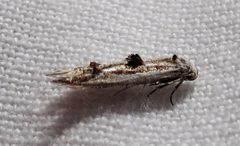
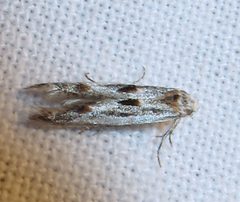
The raised tufts on the forewings—specifically the oblong tuft on the fold and the second tuft at the end—are diagnostic. The small size (12 mm wingspan) and pale ochreous ground color with brown suffusion help distinguish it from other Blastodacna , though specific comparisons to are not documented in available sources.
Images
Appearance
Wingspan 12 mm. Forewings pale ochreous, dusted and suffused with brown. An oblong tuft of dark brown raised present on the fold, with a short brown streak between it and the margin. Another tuft of brown scales at the end of the . part of the wing dark brown.
Distribution
Recorded from Illinois, Indiana, Kentucky, Ohio, and Quebec. GBIF records additionally indicate presence in Alberta, Canada.
Seasonality
active in May and June.
More Details
Original description
Originally described as Gelechia bicristatella by Vactor Tousey Chambers in 1875, later transferred to Blastodacna.
Observation frequency
iNaturalist records 99 observations, suggesting it is encountered with moderate frequency by observers in its range, though this may reflect survey effort rather than true abundance.