
Menesta tortriciformella
Clemens, 1860
Menesta tortriciformella is a small in the Depressariidae, first described by James Brackenridge Clemens in 1860. It is distributed across eastern North America from Florida to Nova Scotia. The has a wingspan of 9–10 mm and distinctive dark forewings with greenish-violet iridescence. Larvae feed on American hazelnut (Corylus americana) and Allegheny blackberry (Rubus allegheniensis).
Pronunciation
How to pronounce Menesta tortriciformella: /mɛnˈɛsta tɔrˌtrɪsɪfɔrˈmɛlla/
These audio files are automatically generated. While they are not always 100% accurate, they are a good starting point.
Identification
Distinguished from similar small Depressariidae by the combination of dark forewings with greenish-violet iridescence and contrasting much lighter hindwings. The indistinct white transverse line on the forewing, formed by scattered white , is a subtle but useful character. The small size (9–10 mm wingspan) and eastern North American distribution help separate it from western .
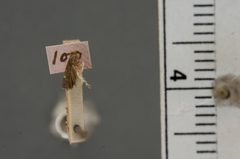
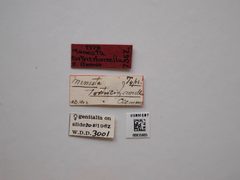
Images
Appearance
A small with wingspan 9–10 mm. Forewings are blackish brown with greenish-violet reflections; a few white just beyond the middle form an indistinct, short, transverse line. Hindwings are much lighter brown than forewings.
Distribution
Eastern North America: recorded from Florida, Georgia, Illinois, Kentucky, Maryland, Mississippi, New Hampshire, New Jersey, New York, Ohio, Pennsylvania, Virginia, Vermont, Ontario, and Nova Scotia.
Diet
Larvae feed on Corylus americana (American hazelnut) and Rubus allegheniensis (Allegheny blackberry). diet unknown.
Host Associations
- Corylus americana - larval food plantAmerican hazelnut
- Rubus allegheniensis - larval food plantAllegheny blackberry
Similar Taxa
- Other Menesta speciesSimilar small size and general form; distinguished by wing coloration, pattern details, and geographic distribution. Many western occur outside the range of M. tortriciformella.
- Tortricidae (leafroller moths)General resemblance in resting posture and size suggested by the epithet 'tortriciformella' (Tortrix-like); distinguished by -level characters including wing venation and genitalia structure.
More Details
Etymology
The specific epithet 'tortriciformella' refers to the superficial resemblance of this to in the Tortricidae (leafroller moths).